Foreword
Disagreements and difficult relationships are part of working life. They can arise even in well-managed workplaces. What matters is how we respond to them, and whether we have the confidence and capability to address problems constructively before they worsen.
This analysis brings the consequences of getting that wrong into sharp focus. It estimates the total annual cost of workplace conflict to UK employers at £51.2 billion, equivalent to around £3,700 for each individual directly involved in conflict.
The headline figures are only part of the story. One of the clearest messages from the analysis is that costs rise sharply as conflict escalates. Resolving problems early and informally is the most economical route. Costs mount as conflict affects health and productivity, moves into formal procedures and, ultimately, leads to people leaving their jobs. Behind the economic cost is a human one that defies neat calculation.
The scale of these costs makes effective employment relations a strategic issue for our economy. The consequences extend beyond individual workplaces, and effective conflict management can help support productive workforces and the conditions for growth.
Formal procedures have an important role when they are needed, but they should not be our first response to every disagreement. Wherever possible, we need to create the conditions in which people can raise concerns, have difficult conversations and work through problems before positions become entrenched and costs escalate.
Early resolution needs to be part of how organisations work, not just how individual managers behave. Employers, workers and their representatives all have a part to play. Building confidence and capability across the workplace can help people manage differences well and find informal resolutions where appropriate.
This goes to the heart of Acas's strategy. We want to prevent conflict where we can. But where conflict cannot be prevented, we want to help people disagree well at work. At a cost of more than £50 billion a year, the economic case for doing so is clear from this analysis. I hope it encourages organisations to invest in the skills, systems and cultures that make effective conflict management possible.
Baroness Maggie Jones
Acas Chair
Executive summary
Background and approach
In 2021, Acas commissioned the first detailed economic estimate of the costs of individual workplace conflict in the UK, drawing on survey data collected in 2019. Since 2019, the employment landscape has changed profoundly, shaped among other things by the pandemic, sustained inflation, shifts in bargaining power and the rapid growth of artificial intelligence use.
This report updates and expands the 2021 analysis using new Acas-commissioned survey data on workplace conflict collected in 2025. Drawing on these data, costs of conflict are estimated across 4 dimensions, reflecting different stages of escalation:
- informal resolution, in discussions with managers, HR practitioners and employee representatives
- formal workplace procedures, including grievance and disciplinary processes
- sickness absence, reduced productivity through presenteeism, and exit
- employment tribunal proceedings
The analysis focuses on costs borne by employers rather than the net cost to the broader economy.
Key findings
Workplace conflict is widespread, affecting an estimated 14 million employees across the UK in 2025. The analysis estimates the total annual cost of workplace conflict to UK employers at £51.2 billion, or £1,690 per employee and £3,658 for each individual directly involved in conflict.
The largest costs were those connected with the end of the employment relationship (£29.5 billion), with an estimated 1.6 million employees leaving their job as a direct result of conflict.
More than half of those experiencing conflict report stress, anxiety or depression. Yet most continue working, often with reduced productivity. Sickness absence and presenteeism cost employers £10.5 billion.
Employers spent an estimated £9.8 billion on formal procedures, an average of around £5,000 per procedure. By contrast, informal approaches to conflict resolution cost employers only £758 million (1.5% of the total, including mediation and facilitated conversations), an average of around £60 per conversation (£71 for a conversation with a manager), yet are associated with better resolution outcomes and lower rates of conflict-related exit.
What drives the cost of conflict?
The cost of conflict is highly concentrated in a minority of serious and complex cases. The most expensive 10% of conflicts account for 62% of the total. These are almost all conflicts in which someone left the organisation and are more likely than other conflicts to involve:
- bullying, discrimination or harassment
- misconduct
- the employee's own line manager
Reducing cost is therefore largely a question of preventing escalation. The analysis points to 5 key drivers.
The nature of the conflict
Bullying, discrimination or harassment cost around two and a half times as much as other conflicts, mainly because they often lead to poor mental health, sickness absence and exit. Conflicts with the employee's own line manager cost about double those with a colleague, because around one in 4 ends in exit.
Discussion and conversations
One in 3 conflicts involved no conversation of any kind to try to resolve it, and these had almost twice the odds of ending in exit. Where the conflict was with their own manager, only 13% of those who discussed it with that manager left their job, against 33% of those who did not. In these cases, the odds of exit and the average costs were more than halved.
Formal procedure
Conflicts reaching a formal grievance or disciplinary procedure make up 13% of cases but 40% of the cost, with the procedure itself absorbing around £5,000 per case in staff time. Procedures are concentrated in the most serious cases – 7 in 10 of these cases involve bullying, discrimination, harassment or misconduct.
The impact on individuals
Around a quarter of workers report a long-standing health condition, but conflicts involving them account for 45% of the cost of conflict, mainly because these cases tend to be more serious, particularly linked to bullying and harassment. Meanwhile, under-35s comprise 36% of the workforce but account for 46% of the cost, because their conflicts more often end in exit.
Organisation context
In industries dominated by public employment, conflict is less likely to end in someone leaving, and a similar but weaker pattern is seen in more unionised industries. Formal procedures are no more common here but absorb considerably more staff time. Across all sectors, smaller organisations involve HR less often and use formal procedures less frequently than larger firms.
Variation by industry
Costs per employee are highest in construction (£3,178), followed by professional, scientific and technical activities (£2,578), and information and communication (£2,360). In absolute terms, human health and social work has the highest total estimated cost of conflict (£7.4 billion), although this is partly a function of the large size of the sector.
Exit is the largest component of cost in most industries. The exceptions are public administration, where formal procedure (35% of cost) is slightly larger than exit (31%), and finance and insurance, where sickness absence and presenteeism (40%) slightly exceed exit (38%).
Implications for practice
The findings make a compelling case for early intervention, and for shifting priorities from legal compliance to sustaining and repairing employment relationships: litigation costs employers an estimated £665 million a year, against £29.5 billion from conflict-related exit. The analysis points to the following areas where action is likely to be most effective.
Develop conflict capability across the organisation
Line managers matter, but two-thirds of conflicts do not involve the employee's own manager, and their ability to intervene early depends on the culture and systems set by senior leaders. Employees also need skills to resolve problems, and managers need support with the conflicts they face themselves.
Make it easier to address problems early
A third of employees experiencing conflict do not discuss it with anyone. Where employees discuss conflict, particularly directly with the other person involved, they are more likely to resolve it and less likely to leave as a result, at very low cost. This requires open cultures that encourage people to raise and address problems early.
Focus on the conflicts most likely to escalate
Bullying, discrimination and harassment, misconduct and conflicts with an employee's own manager drive a large share of the cost. Preventing these, and responding quickly, offers the greatest potential savings.
Address absence management and disability
Conflict involving disabled employees, particularly over sickness absence, is disproportionately costly. Supportive approaches to absence and reasonable adjustments should reduce it.
Treat formal procedure as a backstop
Formal procedures may still be necessary in some serious cases, but they absorb almost £5,000 per case in staff time. Their use is not clearly associated with better resolution outcomes, reinforcing the value of earlier informal resolution where appropriate.
Support smaller employers
Conflict is as common in small organisations as in large ones, and costs about the same per case. But small organisations are less likely to have HR expertise to call on. They spend less on formal procedures, but this is offset by the cost of people leaving, and each departure is a larger loss to a small team: around 6% of the workforce is lost to conflict each year, compared with 5% in large organisations. Smaller employers therefore need more support to resolve conflict early.
Implications for policy
Improved managerial and organisational practices will not be delivered without systemic change. Early resolution has to be part of how the organisation works, not just how individual managers behave. Larger organisations need an employment relations strategy built on employee voice, fair procedures and trust. Smaller organisations need leadership and skills development which builds on (and does not replace) informal employment relations cultures. A one-size-fits-all approach is unlikely to work.
The policy framework matters too. An emphasis on early resolution will be vital in guiding employers away from defensive responses to improved employment protection, which will only increase the costs of conflict. The findings point to a need to build on the Acas strategy to prevent, manage and resolve conflict, and to make conflict competence central to efforts to combat economic inactivity and secure good growth.
At more than £50 billion a year (around 1.7% of UK GDP), the cost of conflict in the UK is too large to ignore, and most of it arises after early opportunities to resolve problems have been missed. It costs employers through lost staff and lost productivity, adds to economic inactivity and strains the tribunal system. Effective conflict management should be seen not as a niche concern of HR but as a core component of the UK's economic and industrial strategy.
1. Introduction
1.1 Background and context
In 2021, Acas commissioned the first detailed economic estimate of the costs of individual workplace conflict (Estimating the Costs of Workplace Conflict Report, Saundry and Urwin, 2021). This analysis was largely based on Chartered Institute of Personnel and Development (CIPD) data collected in 2019 and concluded that the overall annual cost to UK employers was £28.5 billion. This underlined the importance of the effective prevention, management and resolution of conflict to organisational performance and productivity.
However, since our 2021 analysis was published there have been significant changes to the context of work and employment. The impacts of the Covid-19 pandemic have continued, reshaping attitudes to work and ways of working. Employee engagement in the UK remains well below pre-pandemic levels ('Engage for Success' report on Nottingham Trent University Open Research Archive, Pass et al., 2025) and evidence from the British Social Attitudes survey suggests job satisfaction is at the lowest level recorded ('Work in progress', Resolution Foundation, 2026). Meanwhile, workplace conflict is more prevalent today than previously recorded, with more than 4 in 10 employees reporting experiencing conflict at work in the previous year ('Prevalence of conflict at work' report, Acas, 2025).
Early conciliation notifications and tribunal volumes have also grown rapidly (Tribunal Statistics Quarterly, Ministry of Justice, 2026). At the same time, the expansion and development of artificial intelligence has the potential to have a profound impact on work and employment (Research into how AI is affecting employment, ONS, 2025) and also on the way that employers and employees navigate conflict at work.
In this context, there are some signs that the negative implications of workplace conflict are beginning to influence aspects of the policy agenda. The potential to reduce the costs of conflict has formed part of the rationale for attempting to improve employment relations through the Employment Rights Act 2025 (UK government, 2026). In addition, the government's Plan for Small and Medium-sized Businesses (published in 2025) cited the 2021 analysis in arguing for improved leadership and management capability in smaller organisations to manage 'disputes and help provide long-term strategic direction for businesses to grow and improve' (Backing your business policy paper, Department of Business and Trade, 2025).
This report updates and expands the 2021 analysis, drawing on an Acas-commissioned National Centre for Social Research (NatCen) Opinion Panel survey of workplace conflict conducted in 2025 – the largest and most robust of its kind (further details are provided in the Technical Appendix). While this report follows the approach of the previous study, the new dataset:
- provides an opportunity to develop more robust estimates and enhanced analysis
- allows us to develop sector-specific estimates of the cost of conflict
- gathers more precise data which separates disciplinary and grievance procedures
- focuses more closely on the experiences of those with line management responsibilities
We have also worked with Acas and the CIPD to develop more accurate estimates of the costs associated with informal resolution and managing formal procedures. In addition, we have revised (and strengthened) our approach to estimating the costs associated with an ending of the employment relationship. This is important as this element makes up the largest component of the overall cost of workplace conflict.
The report is structured as follows:
- in section 1 we set out the context for the study and explain our analytical approach
- section 2 sets out our conceptual approach to estimating the cost of workplace conflict
- section 3 then draws on a variety of quantitative evidence to examine the nature and extent of individual conflict, before providing estimates along our 4 dimensions
- section 3.1 estimates the costs of informal resolution, and section 3.2 the costs of formal procedures
- section 3.3 considers the costs of sickness absence and presenteeism, and section 3.4 the costs of resignation and dismissal
- section 3.5 considers the costs of litigation for conflict that is not resolved within the workplace, and section 3.6 draws together these calculations and presents an overall estimate of the cost of conflict
- section 4 examines the factors that shape the cost of conflict, including the nature of the conflict, how it is handled, the characteristics of those involved, and variation by industry sector and organisation size – this points to important implications for policy and practice relating to the effective management of conflict, which we discuss in the concluding section 5 of the report
1.2 The cost of conflict in 2025
A central implication of the analysis contained in this report is that conflict, and its effective management, should be a core strategic concern for organisations. Until recently, this has been a challenging argument to make due to the fact that individual workplace conflict is hard to measure, and good conflict management often goes unseen and unrecognised. In particular, the informal processes of discussion and resolution, which are so crucial, necessarily take place in private and behind 'closed doors' (The challenge of managing informally, Saundry et al., 2015; Forth and Dix, 2016).
The initial cost of conflict analysis, published in 2021 was notable because, for the first time, it provided an insight into the hidden (economic) impacts of conflict and the way in which managers and employees responded and reacted to problems at work. In some respects, this confirmed previous research that had pointed to the crucial role played by line managers and the consequent importance of developing managerial capability ('Strategic conflict management?' ILR Review journal article, Nash and Hann, 2020; Saundry et al., 2016). However, the scale of conflict (35% of the workforce), the consequent cost to employers (£28.5 billion) and the key contribution to cost from an ending of the employment relationship, was perhaps less expected.
In this analysis we focus on estimating the cost of conflict to employers, rather than the overall net cost to the UK economy. For example, we include costs paid to lawyers, mediators, recruiters and advertising agencies. These would normally be excluded from a standard cost benefit analysis (CBA) because they represent a transfer from one economic agent to another, with zero net impact on the economy.
The analysis is primarily based on data drawn from an Acas-commissioned survey conducted by the National Centre for Social Research of working-age people in the UK. Respondents were drawn from a nationally representative probability-based sample with participants selected at random. The survey took place over August to September 2025 and was completed by 4,556 respondents (a 50% response rate). The survey instrument was based on the 2019 survey previously conducted by the CIPD, which formed the basis for the 2021 cost of conflict analysis (Saundry and Urwin, 2021). The definition of workplace conflict remains unchanged, as do the majority of questions on impacts, process and outcomes. However, it was also necessary to make adjustments to questions in order to fill specific gaps in the data and improve clarity. Consequently, we avoid direct comparisons with the 2021 analysis.
In addition to improvements made to the survey instrument, we are grateful to the CIPD for a variety of metrics that improve the accuracy of assumptions made since the 2021 study. For example, we have to decide how much time is involved in a conversation between a manager and employee as they attempt to resolve a conflict. We have information on the proportion of workers taking sickness absence who experience conflict, but how many days of absence are attributable to conflict? Our approach to these and a number of additional assumptions are improved by data from the CIPD Spring Labour Market Outlook survey (CIPD, 2026b) and Good Work Index (CIPD, 2026a) surveys.
We continue to take a cautious and transparent approach to estimation; and it is important to note that cost to employers is inevitably lower than the overall cost to the economy and society. For instance, our discussion of sickness absence considers the wellbeing impacts associated with workplace conflict, but our focus is on the extent to which these have a direct economic impact on employers. Similarly, we assess the costs that employers incur as a consequence of resignation or dismissal but do not capture the implications for government expenditure of any consequent economic inactivity.
2. Framework for estimation
2.1 Conceptualising individual conflict
As in the 2021 analysis, our conceptual starting point is that conflict is an inherent part of the employment relationship. While employers and their workers have areas of mutual interest, some degree of antagonism is inevitable. In terms of individual conflict, this is generally reflected in conflict between managers and workers. However, interpersonal conflict can also develop from differences in attitudes and behaviours, which may be shaped by, but not directly related to, the nature of the employment relationship.
Managers play a key role in minimising, managing and resolving conflict. Research has consistently shown that they are best placed to identify potential problems and intervene at an early point when constructive solutions through informal discussion and negotiation are more achievable (Managing individual conflict research report, Saundry et al., 2016; Teague and Roche, 2012). Critically, managers often lack the confidence and skills to do this (Defining and enabling informal workplace conflict resolution report, Acas 2025b). However, managers do not work in isolation and whether and how they deal with conflict depends on a range of factors, such as the support, training and advice they receive and the design of policy and procedure.
In larger organisations, the role of HR and the quality of relationships with representatives and unions is crucial (Disconnected human resource? – Human Resource Management Journal article, Saundry, Fisher and Kinsey, 2021; Saundry, Jones and Antcliff, 2011). Perhaps most importantly, conflict is less likely, and more easily resolved where effective conflict management is treated as a strategic imperative (Organizational conflict resolution and strategic choice – ILR Review journal article, Lipsky et al., 2020) and there is a 'positive intent' to build mutual trust and respect (A time for consensus policy paper, Acas, 2025d). However, 'positive intent' needs to be fostered and sustained by structures of voice and systemic capability, which in turn are underpinned by government policy and regulation. Inevitably, this shapes the incentives and resources that determine whether organisations prioritise and invest in positive employment relations and cultures of conflict competence.
2.2 Measuring individual conflict
We take a pragmatic, data-driven approach to defining conflict and the framework for analysis. Overall, as in the 2021 analysis, our estimation of the costs of conflict is based on employees who 'report an isolated dispute or incident of conflict or an ongoing difficult relationship'. According to the 2025 Acas survey (weighted to the UK) 46% of respondents experienced conflict (in either their main or secondary job) in the previous 12 months. This equates to around 14 million employees across the UK.
Table 1 shows how this figure varies across sectors of the UK economy. It is important to note that while breakdowns by industrial sector provide useful insights into the different conflict profiles, readers should be cautious about making firm comparisons due to small numbers of respondents in certain industries. This is discussed in further detail in the Technical Appendix.
| Industry sector | % of respondents reporting conflict | Estimated UK employees experiencing conflict |
|---|---|---|
| Human health and social work (750) | 49.8% | 2,482,848 |
| Wholesale and retail trade (475) | 50.5% | 1,597,162 |
| Accommodation, food service, arts and entertainment (307) | 50.3% | 1,026,768 |
| Professional, scientific and technical activities (305) | 38.5% | 779,046 |
| Education (560) | 38.5% | 1,433,083 |
| Information and communication (242) | 48.4% | 778,593 |
| Manufacturing (373) | 47.1% | 1,170,413 |
| Construction (120) | 48.6% | 387,133 |
| Public administration and defence (397) | 50.1% | 1,323,353 |
| Transportation and storage (225) | 46.9% | 700,338 |
| Financial and insurance activities (266) | 40.0% | 706,233 |
| Administrative and support service activities (112) | 37.0% | 275,695 |
| Other industries (425) | 47.4% | 1,339,986 |
| All sectors (4556) | 46.2% | 14,000,650 |
Source: NatCen Workplace Conflict Panel Survey, September 2025 – includes conflict in main and secondary jobs. "Other industries" comprises Agriculture and fishing, Mining and quarrying, Electricity and gas, Water supply and waste, Real estate, and Other services.
We then measure the costs of conflict across 4 different dimensions, broadly reflecting the levels of potential intervention and escalation.
A. Costs incurred by organisations in connection with attempts to resolve issues through informal channels
These include the costs of discussions between the individuals themselves or with line managers, HR practitioners or employee representatives, and also workplace mediation. The main source for this estimate is Acas's 2025 Conflict Prevalence Survey supplemented by data drawn from CIPD's Spring 2026 Labour Market Outlook survey.
B. The cost of formal dispute resolution mechanisms including disciplinary and grievance procedures
The 2021 analysis drew on (dated) measures from the 2011 Workplace Employment Relations Study. Acas's 2025 survey separates out measures of the use of grievance procedures, disciplinary procedures and workplace mediation, enabling a more refined estimate. Measures of the amount of time spent in managing these procedures are drawn from CIPD's Spring 2026 Labour Market Outlook survey, and also Acas Annual Reports.
C. The estimated costs of sickness absence, reduced productivity (presenteeism), resignation and dismissal
These costs are incurred across different stages of escalation. It is important to note that this includes the 19% of employees who reported being involved in conflict but took no action in response. Costs of presenteeism are estimated for the employees in the Acas 2025 survey who report impacts of:
- stress, anxiety or depression
- AND a drop in motivation and commitment
- OR a negative impact on productivity
Sickness absence is also measured in the Acas 2025 survey as a distinct impact. Across both of these measures the cost is lost output (based on earnings from the Annual Survey of Hours and Earnings (ASHE) and days lost from the 2026 CIPD Good Work Index).
The Acas Conflict Prevalence 2025 survey allows respondents to record either resignation or dismissal as an impact of conflict. The costs of resignation and dismissal include direct costs of replacement (recruitment), training and lost productivity while the replacement gets up to speed.
D. The extent of extra-organisational conflict, including that which manifests in Acas early conciliation (EC) notifications, and in some cases, employment tribunal (ET) claims
We draw on a range of employment disputes data, including Acas evaluation data, to estimate the costs in management time of cases at each stage of the litigation process. This also includes costs of representation, settlement and compensation.
Our updated calculations suggest that conflict is widespread in UK workplaces and has the following significant impacts on those involved:
- 46% of employees in the UK experienced conflict at work in the 12 months prior to the survey – experience of conflict was most common among people whose disability had a major impact on their daily life (71%)
- capability and performance issues were the most common topic of conflict (38%) – when asked to identify the person with whom they had the most serious conflict, respondents most commonly named their line manager (32%) or a colleague in their organisation (34%)
- 57% of people who reported conflict experienced stress, anxiety or depression as a result
- of those experiencing conflict, 25% reported that their productivity reduced, 10% took time off work and 10% resigned
While differences of opinion, disagreements and challenge can stimulate creativity and productivity if managed effectively, the Acas survey data highlights the negative consequences for workers and employers when conflict is not resolved at an early stage. This provides us with a unique opportunity to understand the scale of this problem and therefore inform the development of strategies to prevent, manage and resolve conflict in UK workplaces.
3. Conflict in the workplace
This section describes the estimations used to create an overall UK-wide estimate of the cost of conflict.
3.1 The cost of informal resolution
Good practice in conflict management generally advocates the use of informal resolution where possible, resolving workplace conflict through discussion where this is appropriate. According to Acas guidance on raising and dealing with problems at work 'many problems at work can be solved early. If employers encourage workers to raise issues and discuss solutions, they can avoid costly disputes.'
We base our estimate of the cost of informal resolution on data where respondents report dealing with the conflict by discussing the issue with:
- colleagues
- customers and clients
- direct reports
- line managers
- HR practitioners
- employee or union representatives
In addition, we include the costs of facilitated conversations and workplace mediation. The way in which we break down these categories is set out in the Technical Appendix (Section TA4).
3.1.1 Discussion with peers and colleagues
In this category, we include discussions between a respondent and the other person involved in the conflict where that person was a colleague (in the respondent's own or another organisation) or an unspecified "other" party (someone who was not the respondent's manager, direct report, or a client or customer). This type of discussion was reported by 14% of respondents experiencing conflict which translates to 1.96 million employees per year.
At the time of the 2021 analysis, there was a lack of reliable data regarding the length of direct conversations with the other party. However, new CIPD data provides time spent in informal conversations for different types of issue and how this varies by factors such as sector and industry. Section TA4.1 of the accompanying Technical Appendix provides detail of the sector-specific figures used in our calculations. Taken together, these sum to a weighted average of 1.26 hours compared to the 30 minutes previously assumed.
The cost of this time in each industry sector is the relevant median gross hourly pay (Annual Survey of Hours and Earnings, 2025). As in 2021, we only count the time of one party to the discussion, to avoid any double counting when scaling these findings to the total population of UK employees. This is because the survey provides an estimate of the number of employees reporting discussions, not an estimate of the number of discussions. Under these assumptions, the estimated annual cost of informal discussions between peers and colleagues is £59.5 million.
3.1.2 Discussion with clients and customers
Conflicts where the other person was a client or customer (external to the organisation) account for 14.2% of conflict cases, but only 23.1% of these involved a conversation with the client or customer. Conversations with clients or customers therefore occur in 3.3% of all conflict cases, which translates to 459,000 employees having conversations each year. We assume these take the same time as conversations with colleagues or peers.
Peer, colleague, client and customer conversations together cost £73.4 million, of which £13.9 million (19%, in proportion to the number of conversations) relates to clients and customers.
3.1.3 Discussion between line manager and direct report
In order to provide a precise estimate of the extent of discussions between employees and line managers, we pool responses from respondents (in conflict with either a line manager or a direct report) who indicated that they discussed the issue with 'the other person', and those respondents who specifically reported that they dealt with their conflict by having a discussion with their line manager. This approach is outlined in greater detail in section TA4.2 of the Technical Appendix.
Overall, 48.7% of those in conflict discussed the issue with their manager and 4.8% of respondents in conflict discussed the issue with a direct report. When these categories are de-duplicated, just over half (51.2%) of respondents who experienced conflict took part in manager-report conversations. It is important to note that these conversations were not limited to conflicts between managers and their reports. Only about a third of those who had a discussion with their manager were in conflict with them. The rest (32.4% of all conflict cases), talked to their own manager as a support or escalation route for a conflict that was with someone else entirely, most commonly a colleague (21.2%).
In estimating the cost of these discussions, we draw on the CIPD Spring 2026 Labour Market Outlook, which shows an average of 1.24 hours for employees in manager conversations and 1.3 hours for managers. Overall, we estimate 7.2 million employees having conversations, at a cost of £512 million.
3.1.4 Discussion with HR practitioners
Those in conflict had discussions with HR practitioners in 12.4% of cases, a total of 1.7 million employees. HR involvement is more likely in more serious cases – such as bullying and harassment and misconduct, where managers are in conflict with their reports, and in sectors such as health and manufacturing with higher levels of unionisation and more structured approaches to employment relations. However, average time spent by HR in these informal discussions is relatively low at 0.89 hrs per case (less than any other category). Overall, this implies a total cost of HR discussions of £85 million.
3.1.5 Discussion with employee and trade union representatives
Among those respondents who reported conflict, 8.2% had a discussion with an employee or trade union representative, a total of 1.1 million employees. The profile of the cases that tended to involve representatives closely mirrors HR discussions. These tend to be more serious issues – particularly bullying and harassment cases and there is a significant overlap with HR involvement. On average trade union representatives spend 0.96 hours on informal discussions per case, equating to a total cost of £59 million.
3.1.6 Structured informal resolution – workplace mediation and facilitated conversations
In the 2025 Acas survey, 2.4% of those who experienced conflict reported that their most serious conflict had been dealt with using 'workplace mediation with a trained mediator'. This translates to 329,236 mediations across the UK. We would not normally include this in our analysis as this is based on a small number of respondents (36 unweighted, 47 weighted). Moreover, in our view the figure significantly overstates the extent of mediation in the UK. However, mediation is an important part of the UK's conflict resolution machinery and therefore should be included in our overall estimate.
Therefore, we have taken a careful and conservative approach, which reflects our contention that respondents are likely to overstate the extent of workplace mediation, with some employees reporting other types of intervention that sit on the informal and formal boundary as 'mediation'. The Acas survey refers to 'a trained mediator' but does not provide information about the training or professional framework involved or allow us to establish how respondents distinguished mediation from other facilitated interventions. We therefore assume that responses include both mediations and also facilitated conversations. Each of these categories of intervention is costed separately.
We use a range of data to create a more reliable estimate of the extent of internal and external mediations (the underpinning analysis and rationale for our estimates is set out in detail in Technical Appendix section TA4.3). The most reliable source we have is the Centre for Effective Dispute Resolution's (CEDR) Mediation Audit (2025), although this covers civil and commercial mediation more broadly and may not capture the full extent of workplace mediation. It suggests that 21,000 civil and commercial mediations took place across the UK in 2025, and 16% (3,360) of these were workplace mediations. In addition, in 2025 to 2026 Acas conducted 281 mediations - giving a total of 3,641 externally-contracted mediations.
The duration and cost of workplace mediation will vary according to the circumstances of the case and the model of delivery. Drawing on Acas data and consultation with mediation professionals, we assume that each external mediation lasts for 1.5 days (including pre-meetings). The costs include a fee of £1,500 paid to the mediation provider and the time of one manager and one employee. On this basis, we estimate that each external mediation costs £2,109 and the total cost of external mediations is £7.7 million.
It is important to separate out 'internal' mediations conducted by trained mediators within organisations. In the absence of specific and reliable data on the extent of internal mediation, we estimate the size of the UK population of trained mediators. If we assume that each active mediator undertakes an average of 2 mediations per year, this results in an estimate of 11,422 internal mediations. Assuming each of these mediations takes 1.5 days and involves a mediator and 2 disputants, the cost of each mediation is £851 and the total cost of internal mediations is £9.7 million. Overall, we estimate that there are 15,063 mediations per year across UK workplaces, at a total cost to employers of £17.4 million.
This analysis supports our contention that the Acas 2025 survey results significantly overstate the extent of workplace mediation. In our view the most plausible explanation for this is that respondents self-define conversations facilitated by an HR practitioner or a senior manager as mediation. Therefore, these interactions are costed separately as facilitated conversations.
In estimating the number of facilitated conversations, we include all those respondents who report taking part in mediation, but who do not report engaging in any other informal discussions – this is 34.4% of all who report 'mediation', which gives a figure of 108,075 'facilitated conversations' across the UK. Assuming that each facilitated conversation can be proxied by employee and manager time taken in informal conversations and the cost of additional facilitator time, the total cost is £10.5 million.
Overall, the cost of structured informal resolution is £27.9 million per annum.
3.2 The cost of formal procedures
This is the first time a survey of UK employees has allowed identification of employee grievances separately from disciplinary action. This is important because formal capability, absence or disciplinary procedures are usually initiated by employers and managers where they have concerns over an individual employee's performance. By contrast, the majority of formal grievances or complaints are employee-initiated.
The accompanying Technical Appendix section TA5 contains detailed discussion of our approach to estimating the cost of disciplinary and grievance procedures. Overall, we conclude that there were 1.08 million formal capability, absence or disciplinary procedures (7.8% of those in conflict) and 952,044 formal grievances or complaints (6.8% of all those reporting conflict). Overall, the number of formal cases is similar to those reported in the 2021 analysis, although there has been a significant change in the balance, with a higher number of grievances and lower number of disciplinary cases.
3.2.1 Employee grievances
Section TA5.1 of the Technical Appendix provides detail of the estimates on the average amount of time taken by each party for a formal grievance or complaint within each industry sector. These are weighted by 'involvement', that is the % of grievances that each party (for example legal representatives) are typically involved in.
In the absence of reliable data our 2021 analysis relied on assumptions about the amount of time involved in formal procedures. While these assumptions were deliberately conservative, new data suggests they understated the time involved and therefore costs. We previously used a CIPD estimate that each case involved an average of 5 days' total management time.
However, new CIPD Spring 2026 Labour Market Outlook data is much more finely grained and provides a measure of time spent by different participants, including managers, HR practitioners and legal representatives. This suggests that the previous estimate was much too conservative. Using the new CIPD data, the average grievance is estimated to take 23.5 days of staff time, against the 5 days of management time assumed in 2021. This comprises:
- line managers – 4.5 days
- HR staff – 9.5 days (HR managers 4.5, other HR 5.0)
- legal advisers – 3.2 days
- employee – 4.5 days
- union representative – 1.8 days
These are averages across all grievances, weighted by how often each role is involved. We cost each role using median gross hourly pay from the Annual Survey of Hours and Earnings 2025 plus employer on-costs. This gives a cost of £4.8 billion for formal grievance handling. The higher cost reflects both more time per case and a higher incidence of grievances, which is more than twice the level reported in the 2021 analysis.
3.2.2 Formal capability or disciplinary cases
Our 2021 analysis of the cost of formal disciplinary procedures relied largely on data from The 2011 Workplace Employment Relations Study (WERS) and assumptions regarding the time involved in managing disciplinary procedures. Our updated approach uses a careful treatment of the Acas 2025 conflict prevalence survey data and relies on new CIPD data on time spent managing discipline in UK workplaces. This has allowed us to develop a more detailed and realistic measure of time spent by all parties who may be involved in a disciplinary process. Overall, this increases the time burden and consequent cost significantly compared to our 2021 analysis. This approach is explained in full in section TA5.2 of the Technical Appendix.
The case-weighted average of time spent on disciplinary cases is as follows:
- line managers – 4.6 days
- HR staff – 8.7 days
- legal adviser – 1.9 days
- employee – 4.6 days
- union representative – 2.1 days
This provides a total of 21.9 days, more than 3 times higher than the 6 days used in the 2021 analysis. This is slightly lower than the 23.5 days spent on formal grievance cases – disciplinary management absorbs slightly more line manager and union time, while grievances tend to involve greater input from HR and legal specialists.
On this basis, we estimate the overall cost of managing formal disciplinary procedures to be £5.0 billion. This is more than double the estimate in 2021. This is entirely due to the improved data regarding the time involvement of key actors, which suggests that previous assumptions were too conservative.
3.3 Absence and presenteeism
According to the 2025 Acas data, 9.6% of respondents who experienced workplace conflict reported sickness absence as a direct result.
In addition, 76% of respondents who experienced workplace conflict reported one or more of the following impacts:
- stress, anxiety or depression
- reduced motivation or commitment
- a drop in productivity
This suggests that conflict also leads to presenteeism, where employees continue to work while suffering ill health.
3.3.1 Sickness absence
According to the Acas 2025 conflict prevalence survey, 9.6% of those experiencing conflict reported consequent sickness absence. This amounts to 1.34 million employees. To estimate the number of days lost we draw on CIPD data from the 2026 Good Work Index, which is (to our knowledge) the only UK source that allows days of sickness absence to be compared between employees who have, and have not, experienced conflict. This found that respondents who had been involved in conflict, as defined by CIPD (a narrower definition than the one used in the Acas 2025 survey), took 6.9 days off work on average in the past year, compared to 3.8 days for those who had not experienced conflict.
Taking the difference of 3.1 days as the average number of sick days attributable to conflict produces a figure of 43.4 million additional days of absence that are due to conflict. Using an Annual Survey of Hours and Earnings 2025 figure of median earnings in each sector as the cost of a day lost, provides a total cost of £7.4 billion. This is significantly higher than the £2.2 billion cited in our 2021 analysis. The rationale underpinning this estimate is set out in detail in Technical Appendix, section TA 6.1.
3.3.2 Presenteeism – poor health and reduced productivity
In addition to the costs of sickness absence, conflict can have an adverse impact on the productivity of those individuals who continue to work. Some commentators adopt a broad definition of presenteeism as 'attending work while ill' (‘Presenteeism in the workplace’ Journal of Organizational Behaviour article, Johns, 2009). However, for the purposes of estimating the cost to employers of ill-health, we feel that a narrower conception is more appropriate such as that proposed by Shultz and Edington (2007) in their Employee Health and Presenteeism article who define presenteeism as 'decreased on-the-job performance due to the presence of health problems'.
The Acas 2025 survey shows that 57% of those who experience conflict also report suffering from stress, anxiety or depression as a result. To estimate the population affected by presenteeism, we identify employees in this group who also report a drop in motivation, commitment or productivity. Using this approach, 36% of those experiencing conflict exhibited presenteeism, compared with 26% in our 2021 analysis. Around one in 6 of this group also reported sickness absence as an impact of conflict. We include them because the presenteeism estimate captures reduced performance on the days they were at work, separately from the days on which they were absent. In our view, excluding this group would suggest that there were no productivity impacts either before or after returning to work, which is implausible.
Section TA6.2 of the Technical Appendix outlines key findings from an updated review of the literature on presenteeism and its impacts, and shows how this forms a basis for our estimates. Drawing on this literature, we take a conservative approach and estimate that the productivity of affected workers drops by 12% for 30.3 days. This produces an equivalent productivity loss per employee of 3.63 days and a total estimated cost in lost productivity due to presenteeism of £3.2 billion each year.
3.4 Exit - resignation and dismissal
In order to estimate the costs associated with an ending of the employment relationship due to workplace conflict, we develop a combined measure drawing on the Acas 2025 conflict prevalence survey. Respondents were asked to identify resignation or dismissal as impacts of conflict but also whether they had 'left the organisation' as a way of dealing with a conflict situation. This is detailed in section TA7.1 of the Technical Appendix. Overall, we find that 11.5% of respondents exited their organisation as a direct response to conflict - equating to 1.6 million workers across the UK. This compares to around 900,000 in our 2021 analysis. The main driver of the higher estimate is a near doubling of the rate of resignations.
We do not include any financial compensation in this estimate. We have no reliable data to identify cases where some form of compensation or settlement beyond contractual entitlement is paid. Moreover, these numbers are likely to be relatively small. Instead, the costs of employment termination comprise both:
- the costs of lost productivity as a replacement employee gets 'up to speed'
- the logistical costs of replacing a member of staff – those associated with recruitment, induction and training
Our previous estimates relied on a 2014 analysis conducted by Oxford Economics. While this remains an authoritative source of data on the cost of staff turnover for many studies (The economic and social costs of mental ill health report, Cardoso and McHayle, 2024), it is now more than a decade old and focuses on a fairly narrow range of occupations and sectors. Our updated estimation reduces our reliance on this study and refines our approach by increasing sensitivity to industry context and the characteristics of replacement workers. This is explained in detail in the Technical Appendix, sections TA7.3, TA7.4 and TA7.5).
We calculate the cost of a lost week using Office for National Statistics (ONS) data on the labour share by sector and figures on Gross Value Added (GVA at factor cost) by sector (ONS, 2025b). We take the UK median gross hourly pay for each sector (Employee earnings in the UK – ONS 2025) and work out the cost of an employee for one week from the employer perspective (pay multipied by 7.42 hours multipied by 5 days multipied by 1.207 on costs). We calculate the overall cost to an employer of a week of lost output using the ONS labour share figures (ONS, 2024b).
Overall, this produces an annual cost of conflict-related exits of £29.5 billion. Once inflation is taken into account this is only slightly higher (around 4%) than our 2021 estimate. In addition, while there are larger numbers of conflict-related exits compared with 2021, our new approach to the costs of replacement produces a more sector-sensitive estimate.
3.5 The cost of litigation
If conflict is not resolved in the workplace either through informal discussion or formal procedure, employees can decide to make a complaint against their employer through the employment tribunal. This is rare and according to the Acas conflict prevalence survey 2025, fewer than 0.5% of those experiencing conflict filed an employment tribunal claim.
To bring an employment tribunal claim, claimants must first notify Acas which will attempt to conciliate a settlement between the parties – what is known as early conciliation. We estimate the costs incurred by employers, employees and others involved in cases as they progress to various stages of the employment tribunal process, including hearings.
In the 2025 to 2026 financial year there were 154,103 cases, made up of:
- 142,250 employee-initiated early conciliation notices received by Acas
- 6,272 employer-initiated early conciliation requests (Source: Acas, Early Conciliation and Employment Tribunal statistics for 2025 to 2026)
- 5,581 early conciliation notifications submitted to the Labour Relations Agency in Northern Ireland
These cases are classified as either:
- fast-track cases – relatively straightforward cases such as deductions from wages
- standard track – unfair dismissal
- open track – legally complex, involving issues such as discrimination or whistleblowing
This classification is taken into account in our costings.
Overall, we estimate the costs incurred by employers, employees and others at various stages of the process, but we do not include claimants, as doing so would create the potential for double counting. In addition, we do not include the costs of the employment tribunal system. Our approach to estimation is set out in detail in the Technical Appendix, section TA8.
3.5.1 Time spent by managers and other staff
These costs are calculated using estimates of the mean time spent by managers and other staff on a case that gets to each of these stages of escalation, using Acas early conciliation evaluation data, the 2019 Evaluation of Acas individual conciliation (Pedley et al., 2019), and other employment disputes data. Annual Survey of Hours and Earnings 2025 median earnings data are used to calculate the cost of this time. On this basis, our estimates are as follows:
- cost of management time on 104,191 early conciliation cases that do not progress to an employment tribunal claim is estimated at £56.1 million, between submission of early conciliation notice and the end of conciliation
- cost of management time on 44,287 cases that go through early conciliation, progress to an employment tribunal, but do not progress to a hearing is estimated at £204.0 million, between submission of early conciliation notice and the end of the employment tribunal process
- cost of management time on 5,625 cases that go through early conciliation, progress to employment tribunal and are heard is estimated at £28.0 million, between submission of early conciliation notice and the employment tribunal hearing
Overall, the total estimated cost of management time in relation to litigation is £288.1 million.
3.5.2 The costs of advice, support and representation
To calculate the costs of advice and representation, we base estimates on:
- the percentage of employers that have some element of advice, representation, or both
- the proportion of these employers having to pay for some or all of this
- estimates of the median costs incurred by these employers
For representation during the period of early conciliation, we use Acas early conciliation evaluation data, which indicates that between 3% (fast track) and 30% (standard track) of employers had some form of representation at this stage, two-thirds (67.5%) of whom paid for it, at a median cost of £1,450 (mean £1,720). In total the estimated cost of representation, advice and support to UK organisations is £237.2 million each year.
3.5.3 Settlements and tribunal-ordered payments
Compensation payments made by employers to employees are 'transfers' of resource between economic agents and would be excluded in standard cost benefit analysis estimates of impact to the whole economy. However, they are included here, as they are a cost to those employers subject to conflict.
Compensation includes sums agreed as part of the estimated 19,503 early conciliation notifications that are settled by Acas through a COT3 agreement, for which we do not have employment disputes data. Data from the Acas early conciliation evaluation provides data on agreements that include financial payments, and data from Pedley et al (2019) suggest that the median payment (across tracks) is £849 (whilst the mean payment is £4,019). Using a range of employment disputes data for the equivalent figures on settlements at the employment tribunal stage and adding this to the estimated £24.9 million cost to employers of tribunal mandated payments, we estimate a total cost to employers of £139.5 million.
Adding together the various components above, the annual cost of employment litigation to employers amounts to approximately £665 million.
3.6 Overall costs of conflict
The overall costs of workplace conflict are summarised in Table 2. The annual cost of conflict to UK employers is estimated to be £51.2 billion, substantially higher than the £28.5 billion in 2021 even adjusted to approximately £36 billion in 2025 prices. This represents an average of £1,690 per employee in the UK and £3,658 for each individual involved in conflict.
This reflects 2 key components that drive change (in addition to the inflation experienced between the two studies).
First, there has been a real-terms increase in costs, driven by increases in reported conflict (from 35% to 46%) and the consequent reported impacts. In particular, the proportion of workers reporting resigning as a result of conflict in 2025 is 10%, double the figure in our 2021 analysis. In addition, negative impacts on productivity, motivation, and sickness absence are all higher in 2025 than in our 2021 analysis.
Second, the 2025 Acas conflict prevalence survey allowed us to distinguish between disciplinary and grievance procedures and delineate more precisely the relationships between those in conflict. In addition, new CIPD data has provided an opportunity to develop a much more robust and realistic estimation of the time involved in managing formal procedures.
Overall, the available evidence suggests a broad pattern of higher levels of conflict prevalence and more severe associated impacts than reported in the 2021 analysis. Although changes over time should be interpreted with some caution given changes to methodology, this does point towards much higher estimated costs to UK employers.
| Cost component | Annual cost in 2025 |
|---|---|
| Informal discussion | £0.73 billion |
| Workplace mediation | £0.03 billion |
| Employee grievances | £4.76 billion |
| Disciplinary cases | £5.03 billion |
| Sickness absence | £7.36 billion |
| Presenteeism | £3.16 billion |
| Exit | £29.48 billion |
| Litigation | £0.66 billion |
| Total | £51.20 billion |
The different components of the overall cost of conflict reflect costs at different stages of conflict. This is graphically presented in Figure 1 below, which shows that the costs of resolving and managing conflict through discussion, facilitation and mediation (which are typically incurred at the early stages in the conflict lifecycle) are relatively low at £0.76 billion. When issues become formalised, costs increase sharply to £9.8 billion.
In relation to the impacts of conflict, sickness absence and presenteeism together cost £10.5 billion. However, by far the largest costs are connected to the breakdown of the employment relationship amounting to £29.5 billion, 58% of the total. In comparison, the costs incurred as a result of litigation are relatively small at £0.66 billion. It is important to point out that conflict does not necessarily develop in a linear way and the stages in Figure 1 should not be treated as a strict sequence, so we cannot precisely allocate costs across a timeline. Nonetheless, it illustrates that the cost of conflict is driven less by how often it occurs than by how far organisations allow it to escalate.
The costs of early informal resolution are small relative to the costs that follow (formal procedures, sickness absence and presenteeism and, above all, the loss of experienced staff), which together account for the great majority of the total. Our analysis suggests that the greatest scope to reduce these costs lies in resolving conflict early and in maintaining and repairing the employment relationship, which is better for the people involved as well as for employers. This is consistent with the emphasis in the Acas 2025 to 2030 strategy on preventing, managing and resolving conflict (Acas, 2025), and we return to the implications in Section 5.
Figure 1: Annual cost of conflict by stage
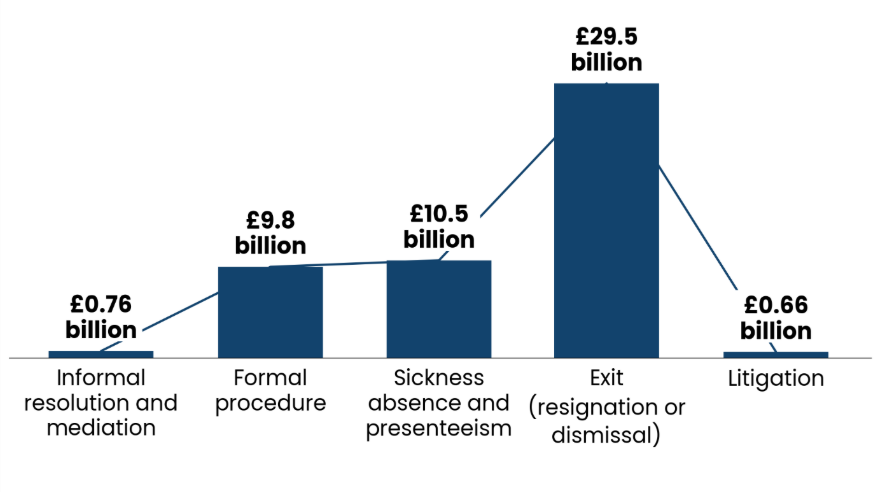
Note: the bars show costs in the order in which they typically arise. The line joins the bars to show the pattern of costs. It does not imply that conflict develops in a fixed sequence.
| Stage | Annual cost | Percentage of total cost |
|---|---|---|
| Informal resolution and mediation | £0.76 billion | 1% |
| Formal procedure | £9.8 billion | 19% |
| Sickness absence and presenteeism | £10.5 billion | 21% |
| Exit (resignation or dismissal) | £29.5 billion | 58% |
| Litigation | £0.66 billion | 1% |
| Total | £51.2 billion | not applicable |
Source: Authors' calculations using the Acas 2025 survey, CIPD Spring 2026 Labour Market Outlook survey and administrative data, Base: annual cost to UK employers, 2025
The importance of early resolution is also illustrated by the uneven distribution of the costs of conflict. The average cost of conflict is £3,658 but the median is only £508. While the majority of conflicts are relatively minor and are more easily managed or resolved, the minority that escalate carry a significant cost. The most expensive 10% of cases account for 62% of the cost. The 11.5% of cases that culminate in someone leaving their job make up more than two-thirds of the cost, and the 13% that involve a formal disciplinary or grievance procedure account for 40% of the cost of conflict. Therefore, minimising the cost of conflict is essentially a question of preventing escalation.
4. What shapes the cost of conflict?
In this section, we explore the factors that influence the cost of conflict. In order to do this, we attach a cost to each case implied by the Acas 2025 survey responses, using the outcomes reported and the cost model which underpins section 3. We then use regression models to see which factors are associated with cost and with key outcomes such as resolution, exit, sickness absence and presenteeism. At the same time, we control for the cause of conflict, roles of those in conflict, disability, age, sex, ethnicity, education, organisation size and industry. Our approach to this analysis is outlined in further detail in section TA10 of the Technical Appendix.
4.1 The nature of the conflict
The strongest predictor of the cost of conflict is the nature of the conflict - what it is about, and who it is with (see Table 3 below). For example, a conflict that involves bullying, discrimination or harassment costs around two and a half times as much as conflicts without these issues, after allowing for who the conflict was with, what else it was about and the characteristics of the person affected. This is driven by the harm such conflicts cause – respondents involved in this type of conflict have 3 times the odds of reporting stress, anxiety or depression (76% against 50%), almost 5 times the odds of taking sickness absence (23% against 5%) and 3 times the odds of leaving their job (21% against 8%). Misconduct cases cost around 85% more. While this is partly because such cases are more likely to involve employee exit, it also reflects the costs of managing formal procedures.
Conflicts between an employee and their own line manager, or between an employee and a more senior person outside their line of management, cost about twice as much as conflicts between colleagues (Table 3). Part of the reason is that these conflicts more often end with the employee leaving: almost one in 4 conflicts with a line manager end this way, compared with fewer than one in 10 conflicts between colleagues. Once the nature of the conflict is controlled for, sex, ethnicity, education, managerial status and organisation size do not make a significant difference to cost. However, where an employee's long-term condition limits their daily life a lot, conflicts cost about one and a half times as much.
Although age is not independently associated with the cost of a case, younger workers account for a disproportionate share of the cost of conflict – under-35s comprise 36% of the workforce but account for 46% of the cost, because their conflicts more often end in exit. Even after controlling for the nature of the conflict, they have almost twice the odds of leaving.
| Factor | Comparison | Ratio of estimated costs | Likely range (95% confidence interval) |
|---|---|---|---|
| Bullying, discrimination or harassment | Conflicts without this cause | 2.49 (sss) | 2.01 to 3.10 |
| Misconduct | Conflicts without this cause | 1.85 (sss) | 1.42 to 2.41 |
| Sickness absence | Conflicts without this cause | 1.41 (s) | 1.02 to 1.94 |
| Terms and conditions | Conflicts without this cause | 1.25 (s) | 1.00 to 1.57 |
| Capability and performance | Conflicts without this cause | 1.18 | 0.91 to 1.52 |
| Health and safety | Conflicts without this cause | 1.29 | 0.90 to 1.84 |
| Personal disagreements or relationships | Conflicts without this cause | 0.85 | 0.67 to 1.08 |
| Own line manager | Conflict with a colleague | 1.94 (sss) | 1.48 to 2.55 |
| Senior person outside line of management ('other') | Conflict with a colleague | 2.05 (ss) | 1.34 to 3.15 |
| Direct report | Conflict with a colleague | 0.80 | 0.55 to 1.18 |
| Client or customer | Conflict with a colleague | 0.589 (s) | 0.36 to 0.94 |
| Condition limits daily life a lot | No long-standing condition | 1.52 (s) | 1.09 to 2.11 |
| Condition limits daily life a little | No long-standing condition | 1.25 | 0.93 to 1.69 |
| Condition, no limitation | No long-standing condition | 1.38 | 0.96 to 2.00 |
| Aged 25 to 34 | Aged 35 to 44 | 1.29 | 0.95 to 1.74 |
| Aged 55+ | Aged 35 to 44 | 1.03 | 0.76 to 1.39 |
| Female | Male | 1.06 | 0.84 to 1.34 |
| Ethnic minority | White | 0.76 | 0.57 to 1.03 |
| Respondent is a manager | Not a manager | 1.18 | 0.91 to 1.51 |
| Small organisation (fewer than 50) | Large organisation (250 or more employees) | 1.06 | 0.80 to 1.39 |
Source: Acas 2025 Survey. Base: 1,936 respondents who experienced conflict.
The ratios compare the typical cost of different types of conflict, allowing for the other factors in the table. A ratio of 1.00 means the estimated cost is the same as for the comparison group, 2.00 means twice the cost and 0.50 means half. For example, the ratio of 2.49 for 'bullying, discrimination or harassment' means that conflicts involving these issues cost around two and a half times as much as conflicts that do not involve them.
Significance is shown in brackets:
- s = significant at 0.05 or 5% level
- ss = significant at 0.01 or 1% level
- sss = significant at 0.001 or 0.1% level
“Own line manager” means the respondent is in conflict with their own manager.
4.2 Informal discussion and resolution
Conversations with colleagues, managers and other sources of support are the least expensive part of the conflict process, making up just 1.4% of the overall cost of conflict. For example, on average a conversation with a manager costs £71 compared to around:
- £5,000 for grievances and disciplinary cases
- £5,502 for a period of conflict-related absence
- £18,364 if an employee leaves the organisation
One in 3 respondents who reported their conflict as at least partly resolved cited informal discussion as the most important factor, more than twice that of all the formal and third-party routes put together.
It is important to note that 1 in 3 conflicts involved no (informal) conversation or discussion. In two-thirds of these cases, the respondents concerned just 'let the issue go'. However, cases were less likely to be seen as resolved than those where discussions had taken place and had almost twice the odds (odds ratio 1.90) of ending in exit (see Table 4). In short, conflicts that were talked about were more likely to be resolved and less likely to lead to someone leaving the organisation.
While the data suggests that 'talking' has a positive impact on conflict situations, who is involved in talking matters. Direct conversations between those in conflict areis strongly associated with perceptions of resolution. But conversations in peer-to-peer conflict are not associated with lower exit or absence. This suggests that their main contribution is to resolve more straightforward day-to-day disputes before they escalate. If we look at conversations between managers and their reports a very different picture emerges.
4.3 The role of managers
Conversations between managers and their reports can have a very powerful impact (see Table 4). Where an employee has a discussion with the manager with whom they are in conflict, the odds of exit and the average cost of conflict are more than halved (odds ratio 0.42; £4,002 compared with £8,589).
This reaffirms the central role played by managers both as parties to conflict but also in effective conflict resolution. Just under one in 3 conflicts are with the employee's own line manager, and these conflicts tend to be particularly costly (around twice the cost of a conflict with a colleague) mainly because they often end in exit. Around one in 4 results in the employee leaving, 3 times the rate for conflicts between colleagues. Conflicts with line managers account for more than two-thirds of all conflict-related exits.
| How the conflict was handled | % of cases | Resolved | Exit | Resolved (Odds ratio) | Exit (Odds ratio) | Absence (Odds ratio) | Impact cost |
|---|---|---|---|---|---|---|---|
| Talked directly with a peer, client or customer | 20% | 59% | 8% | 1.71 (ss) | 1.50 | 0.84 | 1.17 |
| Raised with own manager – conflict was with that manager | 18% | 41% | 13% | 1.35 | 0.42 (s) | 1.03 | 0.52 (sss) |
| Manager brought in – conflict was with someone else | 31% | 54% | 5% | 1.02 | 0.62 | 1.15 | 0.92 |
| HR involved | 10% | 43% | 24% | 1.23 | 1.41 | 2.05 | 1.30 |
| Trade union or employee representative involved | 8% | 41% | 10% | 1.02 | 0.54 | 1.65 | 1.00 |
| No conversation of any kind | 33% | 43% | 17% | 0.75 | 1.90 (s) | 0.69 | 1.42 (s) |
| All conflicts (excluding downward cases) | 100% | 48% | 12% | not applicable | not applicable | not applicable | not applicable |
Source: Acas 2025 Survey. Base: 1,680 respondents who experienced conflict, excluding managers describing a conflict with someone they manage. Percentages weighted. Significance is shown in brackets: s = significant at 0.05 or 5% level; ss = significant at 0.01 or 1% level; sss = significant at 0.001 or 0.1% level.
In some situations, HR support may be needed, and employees may also seek their own representation. The data show that HR and union representatives are drawn into the most serious and complex cases. Around 45% of conflicts involving HR or a representative concerned bullying, discrimination or harassment, compared with 22% of other conflicts. These cases will tend to have worse outcomes, but once the nature of the conflict is taken into account, neither HR nor trade union involvement is significantly associated with resolution, exit, sickness absence, stress or cost. This does not mean that their involvement has no value – the Acas survey does not measure perceptions of fairness, employee voice or legal compliance, and the numbers involved are small.
4.4 Formal procedure
Formal procedures account for a disproportionate share of the cost of conflict. Conflicts involving a formal grievance or a disciplinary, capability or absence procedure make up 13% of cases but 40% of the total cost. They cost an average of £10,864, compared with £2,495 for other conflicts, and the time spent on the procedure itself accounts for 48% of that average.
Not surprisingly, formal procedures are concentrated in the most serious conflicts, which have more negative outcomes. The key question is whether procedures add to the harm or simply reflect it. The relatively small number of formal cases means that associations with specific outcomes should be treated with caution. For disciplinary procedures, the evidence suggests that the negative impacts stem largely from the nature of the underlying problem – once this is taken into account, they are not associated with higher stress, absence or resignation.
Grievances are associated with higher stress and absence even after controlling for the nature of the conflict. The main effect of formal procedures on cost is the time they absorb. This accounts for more than three-fifths of the additional cost of a formal case. Every conflict resolved before it reaches a formal procedure avoids, on average, around £5,000 in procedural costs alone.
4.5 Disability and long-standing health conditions
In the 2025 Acas survey, 24% of those in paid work report a long-standing health condition, and 16.5% say it affects their day-to-day life. This is close to the official figure of 5.5 million disabled people in employment (Department for Work and Pensions, 2025), around one in 6 of those in work. We use 'disabled' to refer to respondents whose condition affects their day-to-day life.
There is a strong association between the cost of conflict and disability. While one in 4 respondents report a long-standing health condition, they account for 45% of the total cost of conflict. Respondents with a disability that limits their daily life a lot have more than 3 times the odds of experiencing conflict (71%, against 44% of those without a condition – odds ratio 3.31), and the average costs of conflict are more than twice as high.
This is driven by the nature of the conflict. Disabled employees are twice as likely to cite bullying, discrimination or harassment and 4 times as likely to report conflict over sickness absence (25% against 6%). Even after controlling for the nature of the conflict, those with a long-standing condition have between 3 and 6 times the odds of conflict-related sickness absence, and those whose condition limits their daily life have significantly higher odds of presenteeism (odds ratios 1.74 to 1.89).
Conflicts are also more likely to be with their own manager and those whose condition limits them a lot in daily life are less likely to discuss it with their manager but more likely to raise it with HR. This suggests that conflict in these cases particularly revolves around the relationship between manager and employee (see also Mitchell et al., 2026).
4.6 Sector and organisational size
Table 5 shows the cost of conflict by industry sector. Costs per employee are highest in construction (£3,178), professional, scientific and technical activities (£2,578) and information and communication (£2,360), and lowest in financial and insurance activities (£975) and manufacturing (£1,233). Part of this reflects pay – higher wages and output raise the cost of each outcome, particularly exit. But the larger difference lies in how conflict is handled, and in particular in the balance between exit and procedure.
| Industry | Total cost | Cost per employee (total employees) | Exit (% of cost) | Procedure (% of cost) |
|---|---|---|---|---|
| Construction | £2.53 billion | £3,178 | 92% | 3% |
| Professional, scientific and technical | £5.22 billion | £2,578 | 64% | 17% |
| Information and communication | £3.80 billion | £2,360 | 62% | 10% |
| Accommodation, food, arts and entertainment | £4.75 billion | £2,324 | 67% | 17% |
| Other or industry missing | £5.05 billion | £1,787 | 72% | 13% |
| Public administration | £4.58 billion | £1,733 | 31% | 35% |
| Wholesale and retail | £4.96 billion | £1,569 | 64% | 15% |
| Health and social work | £7.39 billion | £1,483 | 38% | 33% |
| Education | £4.91 billion | £1,317 | 63% | 15% |
| Transport and storage | £1.96 billion | £1,309 | 74% | 10% |
| Manufacturing | £3.06 billion | £1,233 | 53% | 28% |
| Financial and insurance | £1.72 billion | £975 | 38% | 19% |
| Administrative and support | £0.60 billion | Not reported | Not reported | Not reported |
| All sectors | £51.2 billion | £1,690 | 58% | 19% |
Source: Acas 2025 Survey
Table notes
Four sectors had 50 to 99 respondents who experienced conflict and should be treated with caution:
- construction
- information and communication
- transport and storage
- financial and insurance
One sector had fewer than 50 respondents: administrative and support. Figures are not reported, in line with the thresholds in Technical Appendix Table TA1.
Costs per employee are the total cost for the sector divided by the total number of employees in the sector (not just those in conflict).
Across sectors, the share of cost connected with exit and formal procedure is associated with the structure of employment, including the extent of unionisation. Where employment is more structured and unionisation high, exit is less likely, but conflict is more often managed through more extensive formalised procedure.
In industries and sectors in which workers are less likely to be represented and where employment arrangements are more flexible, processes are lighter touch and exit is the more likely consequence of conflict. Therefore, the costs of exit and costs of procedure tend to move in opposite directions. In public administration, procedure (35%) and exit (31%) account for similar shares of cost. In contrast, in accommodation, food and the arts, exit accounts for 67% and procedure 17% – and in construction, exit accounts for 92% and procedure just 3%.
Sectors with higher union density tend to have lower exit rates and a larger share of cost arising from procedure, but the pattern is weak and inconsistent (education has the highest union density but only 15% of its cost arises from procedure).
The same pattern holds for individuals once the nature of the conflict is taken into account. Employees experiencing conflict in industries dominated by public sector employment (public administration and defence, education, and health and social work) have around half the odds of leaving as comparable employees in predominantly private sector industries (odds ratio 0.54).
The more unionised the sector, the less likely conflict is to end in exit, with the odds falling by around a seventh for every 10 percentage points of sector union density (odds ratio 0.86), although this is not statistically significant. The available data does not allow us to separate the effect of union density from that of public sector employment. Lower exit costs in industries dominated by public employment are partly offset by higher procedural costs, leaving no clear difference in total cost per case. Importantly, these conflicts are no more likely to go through a formal procedure. The difference lies in the intensity of procedures, which absorb considerably more time from more people: around 48 person-days for a grievance in public administration, against 13 in wholesale and retail.
Because the Acas survey did not identify respondents' public or private sector status or whether their workplace was unionised, we can explore how both characteristics are associated with the sector patterns observed but cannot distinguish their separate effects.
Conversely, organisation size was measured directly in the survey. Here, we find little difference in the incidence of conflict between small and large organisations. However, small organisations have around half the odds of involving HR (odds ratio 0.56) and much lower odds of using formal procedures (0.39). As a result, they spend around half as much per case on procedure (£471 against £928) but this is largely offset by higher costs of exit.
Small organisations also lose around 6% of employees to conflict. For a firm of 20 employees, that would equate to one or 2 conflict-related departures a year, each representing 5% of its workforce. We cannot tell from these data whether an exit costs a small firm more or less than a large one, but with each departure representing a much larger share of the workforce, the impact on smaller organisations is likely to be proportionately greater.
Taken together, these findings suggest two broad patterns. Where employment relations are more structured (in industries dominated by public sector employment and, to a lesser extent, in more unionised industries and in larger organisations) conflict is more often contained within the employment relationship, at the cost of substantial procedural time. Where employment is less structured, conflict is more often resolved by someone leaving. Neither is a low-cost model. The scope for reducing costs lies neither in more procedure nor in less, but in resolving conflict before either outcome becomes necessary.
5. Conclusions and implications
Our 2021 analysis was the first systematic estimate of the cost of individual workplace conflict in the UK. It was made possible by CIPD survey data (collected in 2019), which allowed us to open up the 'black box' of conflict management and resolution for the first time. However, none of the data on which that analysis was based was specifically designed to measure cost, and consequently we deliberately took a cautious and conservative approach. The analysis in this report has maintained continuity with our earlier work while using new data for a more precise and robust estimate. In particular, we are able to identify the key factors that drive cost and how this varies across sectors, organisations and groups of employees.
5.1 What have we found?
We estimate that workplace conflict cost UK employers £51.2 billion including early conciliation and litigation, around 1.7% of GDP, or £1,690 per employee. This is 80% higher than our 2021 estimate and around 40% higher in real terms. The 2 estimates are not directly comparable in every respect. The surveys differ in design and sample, and our costing methods have been refined. Therefore, they should not be read as a precise measure of change over time. Even so, the findings point to a substantially greater economic impact than we previously estimated. Four factors stand out:
- in 2025, 46% of UK workers reported experiencing conflict, compared to 35% in 2019
- there are more pronounced negative impacts – the proportion of resignations triggered by conflict is around double that reported in 2019, and more workers reported reduced productivity, lower motivation and sickness absence
- formal procedures absorbed more time than we estimated in the 2021 study – this partly reflects better evidence on the staff time that grievance and disciplinary cases absorb, and partly real changes in the extent of key impacts
- informal resolution costs only £0.76 billion (1.5% of the total cost of conflict) but plays a powerful role in reducing negative impacts and, in particular, costs arising from an ending of the employment relationship
It is also notable that much of the human cost is hidden. 57% of those who experienced conflict reported stress, anxiety or depression, yet only 10% took time off work. Most carry on working with reduced motivation or productivity.
Our analysis only measures the economic cost to employers. The wider costs to individuals and to society, in terms of health, wellbeing and lost opportunity, may also be substantial but are not captured here.
5.2 What drives the cost of conflict?
The cost of conflict is highly concentrated in a minority of serious and complex cases. The most expensive 10% of conflicts account for 62% of the total, and the 11.5% that end with someone leaving account for 67%. Therefore, reducing cost is largely a question of preventing escalation. Our analysis points to 5 key drivers.
The nature of the conflict
Conflicts involving bullying, discrimination or harassment cost around two and a half times as much as other conflicts, mainly because they often lead to poor mental health, sickness absence and exit. Conflicts with an employee's own line manager cost around twice as much as those with a colleague. This is because around one in 4 end with the employee leaving.
Discussions and conversations
Informal discussion is the factor most often credited by respondents with resolving conflict, cited almost twice as often as all formal and third-party routes combined. Direct conversations between those in conflict had a powerful impact on outcomes. One third of conflicts involve no conversation of any kind, and these have almost twice the odds of ending in exit. In contrast, where employees talked directly with the person who they were in conflict with, resolution was more likely. Crucially, where the conflict was with their own manager, only 13% of those who raised it with that manager left their job, against 33% of those who did not.
Formal procedure
Conflicts that reach a formal disciplinary or grievance procedure make up only 13% of cases but 40% of the cost, and the procedure itself absorbs around £5,000 per case in staff time. Procedures are concentrated in the most serious cases, and the harm associated with them appears to stem largely from the underlying problem.
Impact on individuals
Employees with long-standing health conditions or disabilities make up a quarter of the workforce but the conflicts they experience account for 45% of the cost of conflict. This is mainly explained by the fact that these conflicts tend to be more serious, with more negative outcomes, particularly linked to bullying and harassment. Under-35s make up 36% of the workforce but the conflicts they experience account for 46% of the cost. This is because their conflicts more often end in exit. This is not a reason to be wary of employing younger people but underlines the value of investing in the skills and support needed to help young workers and their managers navigate workplace problems.
The context and structure of employment relations
In industries dominated by public employment, formal procedures are no more common but absorb considerably more staff time, and conflict is less likely to end in someone leaving. A similar but weaker pattern is seen in more unionised industries. Larger organisations use formal procedure more often. Where employment is less structured and unionisation is lower, procedures are lighter touch and conflict is more likely to end in someone leaving.
At more than £50 billion a year the cost of conflict is not simply a matter of HR practice but is relevant to the government's central economic priorities in 2 ways. First, the Keep Britain Working review argues that employers must lead on prevention and on retaining people with health conditions and emphasises sustained conversations between line managers and employees from the earliest signs of difficulty (Mayfield, 2025). Our findings suggest that conflict, particularly over absence management, bullying and discrimination, is one of the points at which that relationship breaks down.
Similarly, under-35s account for 46% of the cost of conflict because their conflicts so often end in exit. At a time when the Milburn review on GOV.UK has highlighted almost a million young people who are not in education, employment or training (Milburn, 2026), employers' capacity to resolve conflict with early-career workers matters for the stability of young people's pathways into work.
Second, presenteeism, and the output lost while replacements get up to speed, are direct and substantial productivity losses. Therefore, if the UK is to boost 'good growth' which delivers both economic and social benefits (Blog – 'What does Andy Burnham think ‘Good Growth’ is?', Centre for Cities, Tulasiewicz, 2026), the ability of employers to create positive employment relations and manage conflict more effectively is crucial.
5.3 What are the implications for policy and practice?
These findings make a compelling case for early intervention and a focus on resolving conflict through discussion and early intervention, reflecting the 2025 Acas Strategy to prevent, manage and resolve conflict. They also reinforce a need for organisations to shift their priorities away from legal compliance to sustaining and (where necessary) repairing employment relationships given the relative costs of litigation and conflict-related exit. Litigation costs employers an estimated £0.66 billion a year, compared with £29.5 billion arising from conflict-related exit, so a defensive focus on legal risk addresses only a small part of the cost.
However, this sits within a changing and challenging context. Since the pandemic, economic inactivity has remained at heightened levels (ONS, 2026), driven largely by long-term sickness, which now accounts for around 2.8 million people of working age, almost three-quarters of a million more than in 2019 (ONS, 2025d). Workers have experienced almost 2 decades of weak real pay growth (Resolution Foundation briefing note - Putting the 2024 spring budget in context, 2022; Aref-Adib et al, 2024), while employee engagement in the UK, at just 10%, remains among the lowest in Europe and has barely moved in recent years (State of the Global Workplace report, Gallup, 2026). At the same time, the Employment Rights Act 2025 has extended employment protection, and the rapid spread of generative AI has made it far easier for employees to frame concerns as formal, legally structured grievances and claims. The Employment Tribunal National User Group has reported that this is already contributing to more complex and expansive litigation (Blog - AI in the workplace: What are we seeing? Addleshaw Goddard, 2026).
There is a real risk that such developments encourage formalised and adversarial responses rather than early, informal resolution. In essence, we have an employment landscape that is ripe for conflict at a time when many organisations and managers lack the capability to address and resolve it (Acas, 2025b; Chartered Management Institute, 2023; Saundry and Urwin, 2021). In terms of practice, the analysis clearly points to where employers should target action.
Focus on the conflicts most likely to escalate
Bullying, discrimination and harassment, misconduct and conflicts with an employee's own manager drive a large share of the cost. Preventing these, and responding quickly when they arise, offers the greatest potential savings.
Make it easier to raise problems early
A third of conflicts are never discussed with anyone. Conflicts that are talked about, particularly directly with the other person, including a manager, are more likely to be resolved and less likely to end in exit, at a very low cost. This requires open organisational cultures that emphasise employee voice.
Develop conflict capability across the workforce
Managers matter, but two-thirds of conflicts do not involve the employee's own manager, and the most effective conversations depend on both parties. All employees need the confidence and skills to raise and respond to issues constructively, and managers need support with the conflicts they face.
Address absence management and disability
Fair, supportive approaches to sickness absence and reasonable adjustments, and action on bullying and discrimination, are likely to reduce both conflict and its cost for the employees most affected.
Treat formal procedure as a backstop
Procedures are needed for serious cases, but they absorb around £5,000 per case in staff time and are not associated with better resolution. Every conflict resolved before it reaches that stage avoids that cost.
However, these actions require systemic change that will only take place within a supportive organisational and policy framework. At the level of the organisation, employers need to make early resolution part of how the organisation works, not just how individual managers behave.
Line managers are usually the first point of contact, but their ability to intervene early depends on the culture, systems and expectations set by senior leaders. This requires employers to adopt a strategic approach which positions good employment relations as an organisational priority and as a basis for sustainable improvements in employee engagement and organisational performance. What this looks like will necessarily vary between sectors and organisations. As the sectoral variations in our analysis suggest, a one-size fits all approach is unlikely to work.
Larger organisations need an employment relations strategy, which commits the organisation to resolving problems at the earliest point. This should rest on a foundation of strong employee voice, fair procedures and a culture of trust and mutual respect. A key component of this strategy is an integrated approach to conflict management which:
- develops conflict competence at every level including managers, employees, HR and employee representatives
- creates fair and well understood procedures that emphasise resolution and that are integrated with the provision of mediation and other mechanisms of alternative dispute resolution
- gathers robust data on key conflict indicators to help target strategic interventions
In smaller organisations, while extensive strategies may be less realistic, the key to embedding early resolution and minimising the costs of conflict will be leadership and skills development that lean into the informal nature of employment and give managers the tools to confidently navigate employment relations.
Whether organisations make this investment will depend on the wider policy framework, and the Employment Rights Act 2025 cuts both ways. Cutting the qualifying period for unfair dismissal claims to 6 months (from January 2027) gives employers a reason to resolve problems earlier, and stronger employee voice should support more collaborative relationships. But employers may respond defensively, with more rigid procedure or by ending contracts before 6 months' service. That may reduce litigation risk, but our analysis shows it would almost certainly raise the overall cost of conflict.
Early resolution also relieves pressure on the employment tribunal system. The route to litigation runs largely through the outcomes that early resolution prevents, so every conflict resolved informally is one fewer potential claim.
Government therefore has a strong interest in supporting employers towards early resolution. The Acas 2025 to 2030 strategy (Acas, 2025c) and the draft revised Code of Practice on Disciplinary and Grievance Procedures (Acas, 2026b) provide the framework, but they need to be matched by investment in capability, particularly for smaller employers (Backing your business, Department for Business and Trade on GOV.UK, 2025). Conflict resolution could also be linked to government priorities on economic inactivity and 'good growth', using mechanisms such as the Employer Vanguard set up after the Mayfield review and the Good Employment Charter championed in Greater Manchester.
At more than £50 billion a year, the cost of conflict is too large to ignore, and most of it arises after early opportunities to resolve problems have been missed. It:
- costs employers through lost staff and lost productivity
- adds to economic inactivity
- places growing strain on the employment tribunal system and on Acas's early conciliation service
Therefore, conflict management should not be seen as a niche concern of HR, but as central to the UK's economic and industrial strategy. The challenge is to help organisations of all sizes build, at scale, the capability, systems and cultures that allow conflict to be addressed early, fairly and constructively.
References
Acas (2025a) How prevalent is individual conflict at work in Great Britain in 2025?. Acas
Acas (2025b) Defining and enabling informal workplace conflict resolution. Acas
Acas (2025c) Acas strategy 2025 to 2030. Acas.
Acas (2025d) A time for consensus: how can workplace collaboration be built from organisation to nation. Acas.
Acas (2026a) 'Annual report and accounts 2025 to 2026'. Acas.
Acas (2026b) 'Consultation on the draft Code of Practice on disciplinary and grievance procedures'. Acas.
Addleshaw Goddard (2026) 'AI in the workplace: what are we seeing?'. Addleshaw Goddard.
Aref-Adib, C et al (2024) 'Back for more? Putting the 2024 Spring Budget in context', London: Resolution Foundation.
Cardoso, F and McHayle, Z (2024) The Economic and Social Costs of Mental Ill Health. Centre for Mental Health.
CEDR (2025) The Eleventh Mediation Audit. Centre for Effective Dispute Resolution.
Chartered Institute of Personnel and Development (CIPD) (2026a) Good Work Index 2026. London: CIPD.
Chartered Institute of Personnel and Development (CIPD) (2026b) Labour Market Outlook – Spring 2026. London: CIPD.
Chartered Management Institute (2023) 'Taking responsibility: why UK PLC needs better managers', London: CMI
Department for Business and Trade (2025) 'Backing your business: our plan for small and medium-sized businesses', London: Department for Business and Trade.
Gallup (2026) 'State of the global workplace: 2026 report', Washington, DC: Gallup.
Johns, G (2010) 'Presenteeism in the workplace: a review and research agenda', Journal of Organizational Behavior, 31, pages 519 to 542.
Lipsky, DB, Avgar, AC and Lamare, JR (2020) 'Organizational conflict resolution and strategic choice: evidence from a survey of Fortune 1000 firms', ILR Review, 73(2), pages 411 to 430.
Mayfield, C (2025) 'Keep Britain Working review: final report', London: Department for Work and Pensions.
Milburn, A (2026) 'Young people and work: interim report', London: Department for Work and Pensions.
Ministry of Justice (2026a) 'Tribunal statistics quarterly: January to March 2026', London: Ministry of Justice.
Ministry of Justice (2026b) 'Tribunal statistics quarterly: April to June 2026', London: Ministry of Justice.
Mitchell, M., McKaskill, M., Robertson, K., Bessant, C. and Brown, A. (2026) Disabled employees' experiences of workplace conflict. Acas.
Nash, D and Hann, D (2020) 'Strategic conflict management? A study of workplace dispute resolution in Wales', ILR Review, 73(2), pages 411-430.
National Centre for Social Research (2025) 'Workplace conflict panel survey, 2025' [dataset], commissioned by Acas, London: National Centre for Social Research.
Office for National Statistics (2024a) 'Labour disputes in the UK' [dataset]. ONS.
Office for National Statistics (2024b) 'Trends in the UK labour share: 1997 to 2023'. ONS.
Office for National Statistics (2025a) Annual Survey of Hours and Earnings (ASHE), 2025. ONS.
Office for National Statistics (2025b) Gross Value Added (GVA) and labour share by industry. ONS.
Office for National Statistics (2025c) 'Research into how artificial intelligence is affecting employment'. ONS.
Office for National Statistics (2025d) 'Labour market overview, UK: December 2025'.ONS.
Office for National Statistics (2026) 'Labour market overview, UK: June 2026'. ONS.
Oxford Economics (2014) The Cost of Brain Drain: Understanding the financial impact of staff turnover. London: Oxford Economics and Unum.
Pass, S, Court-Smith, J, Clarke, N, MacLeod, D, Liu-Smith, Y-L and Popescu, S (2025) Engage for Success: UK employee engagement survey 2025: why employee engagement is central to Keeping Britain Working. Engage for Success.
Pedley, K., Clemence, M., Writer-Davies, R. and Spielman, D. (2019) Conciliation 2019: Evaluations of Early Conciliation and conciliation in Employment Tribunal applications. Acas.
Resolution Foundation (2022) 'Help today, squeeze tomorrow: putting the 2022 Autumn Statement in context', London: Resolution Foundation.
Saundry, R, Adam, D, Ashman, I, Forde, C, Wibberley, G and Wright, S (2016) 'Managing individual conflict in the contemporary British workplace'. London: Acas.
Saundry, R., Fisher, V. and Kinsey, S. (2021) Disconnected human resource? Proximity and the (mis)management of workplace conflict. Human Resource Management Journal, 31(2), 476-492.
Saundry, R, Jones, C and Antcliff, V (2011) Discipline, representation and dispute resolution - exploring the role of trade unions and employee companions in workplace discipline. Industrial Relations Journal, 42(2), 195-211 .
Saundry, R, Jones, C and Wibberley, G (2015) 'The challenge of managing informally', Employee Relations, 37(4), pages 428 to 441.
Saundry, R, Saundry, F, Urwin, P, Bowyer, A, Mason, S, Kameshwara, K and Latreille, P (2024) 'Managing conflict at work', London: Acas.
Saundry, R and Urwin, P (2021) Estimating the Costs of Workplace Conflict. London: Acas.
Schultz, AB and Edington, DW (2007) 'Employee health and presenteeism: a systematic review', Journal of Occupational Rehabilitation, 17, pages 547 to 579.
Teague, P., and Roche, B. (2012) Line Managers and Workplace Conflict Management in Ireland. Human Resource Management Journal, 22(3), 235–331.
Tulasiewicz, J (2026) What does Andy Burnham think “Good Growth” is?, Centre for Cities.
UK government (2026) 'Employment Rights Act 2025: economic analysis'. Department for Business and Trade.
van Wanrooy, B, Bewley, H, Bryson, A, Forth, J, Freeth, S, Stokes, L and Wood, S (2013) Employment Relations in the Shadow of Recession: Findings from the 2011 Workplace Employment Relations Study. Basingstoke: Palgrave Macmillan.