
1. Main points
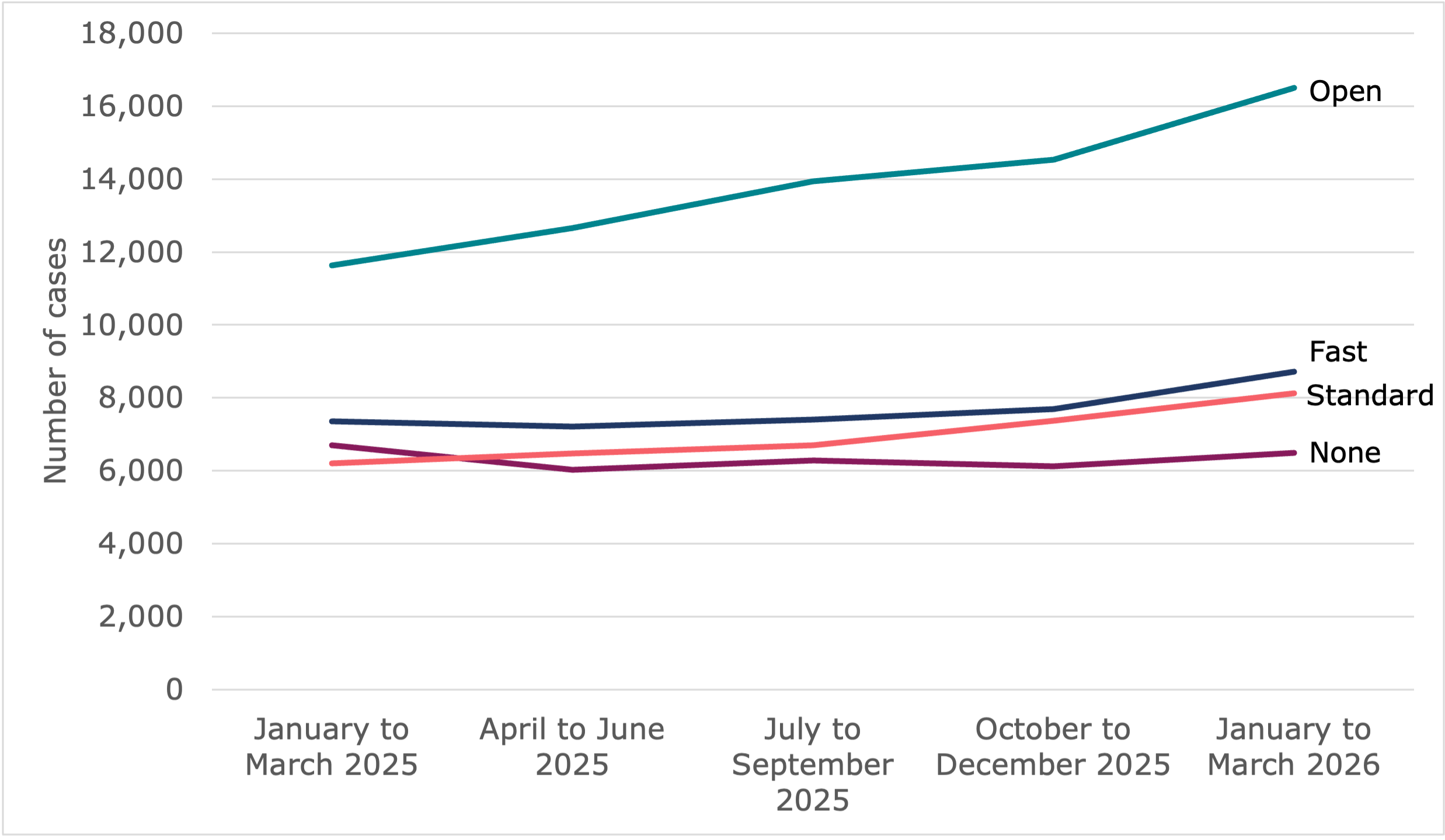
- Open track group cases made up more than half of group cases at 61% for January to March 2026, increasing from 48% in October to December 2025.
- Open track cases accounted for the largest share of worker‑led individual cases between January to March 2026, making up 41% of all cases. However, this proportion remained unchanged from the previous quarter.
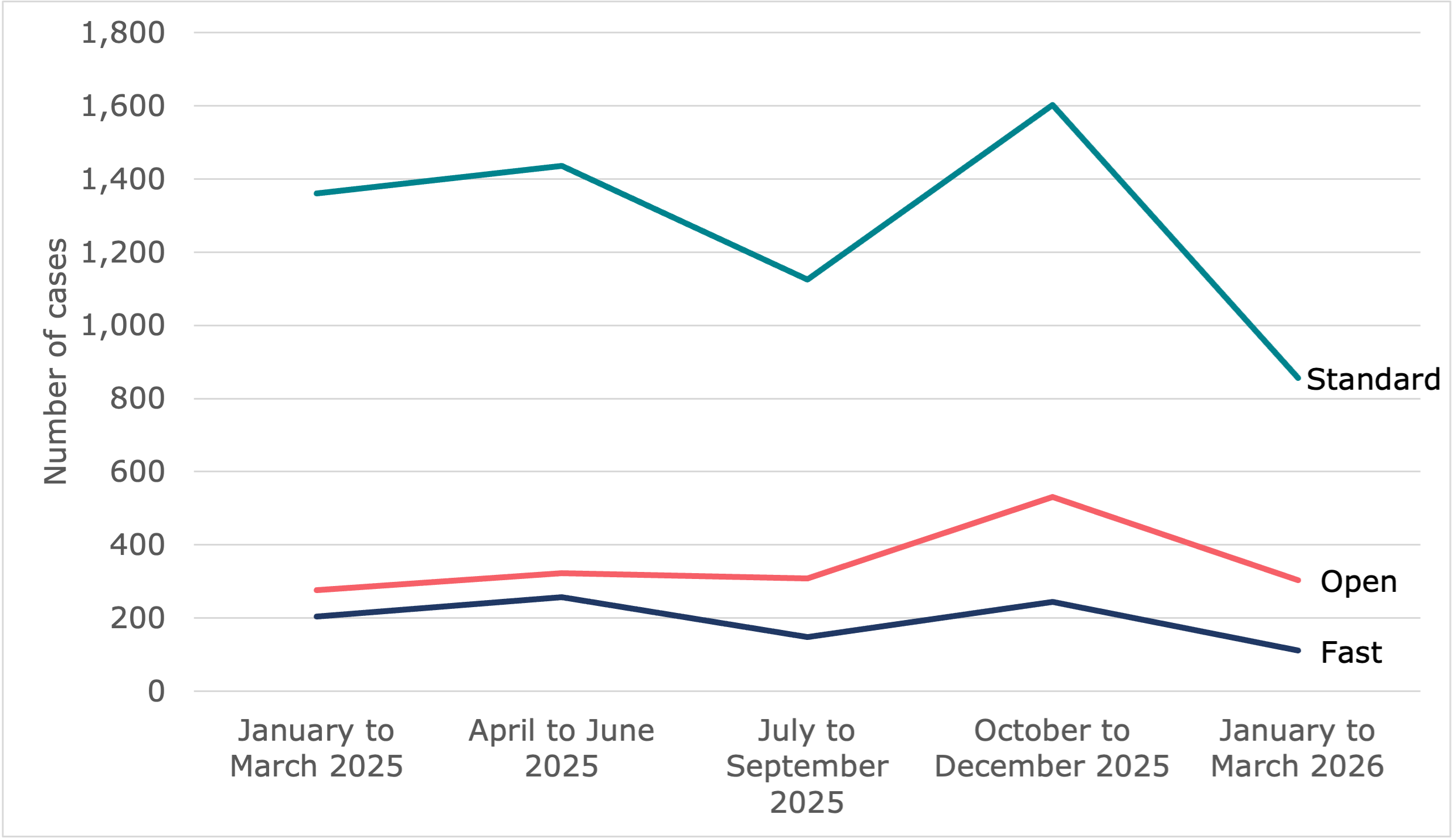
- The total number of employer‑led cases fell to 1,273 in January to March 2026, down from 2,379 in October to December 2025 – a 46% decline, with fast track cases showing the largest drop at 55%.
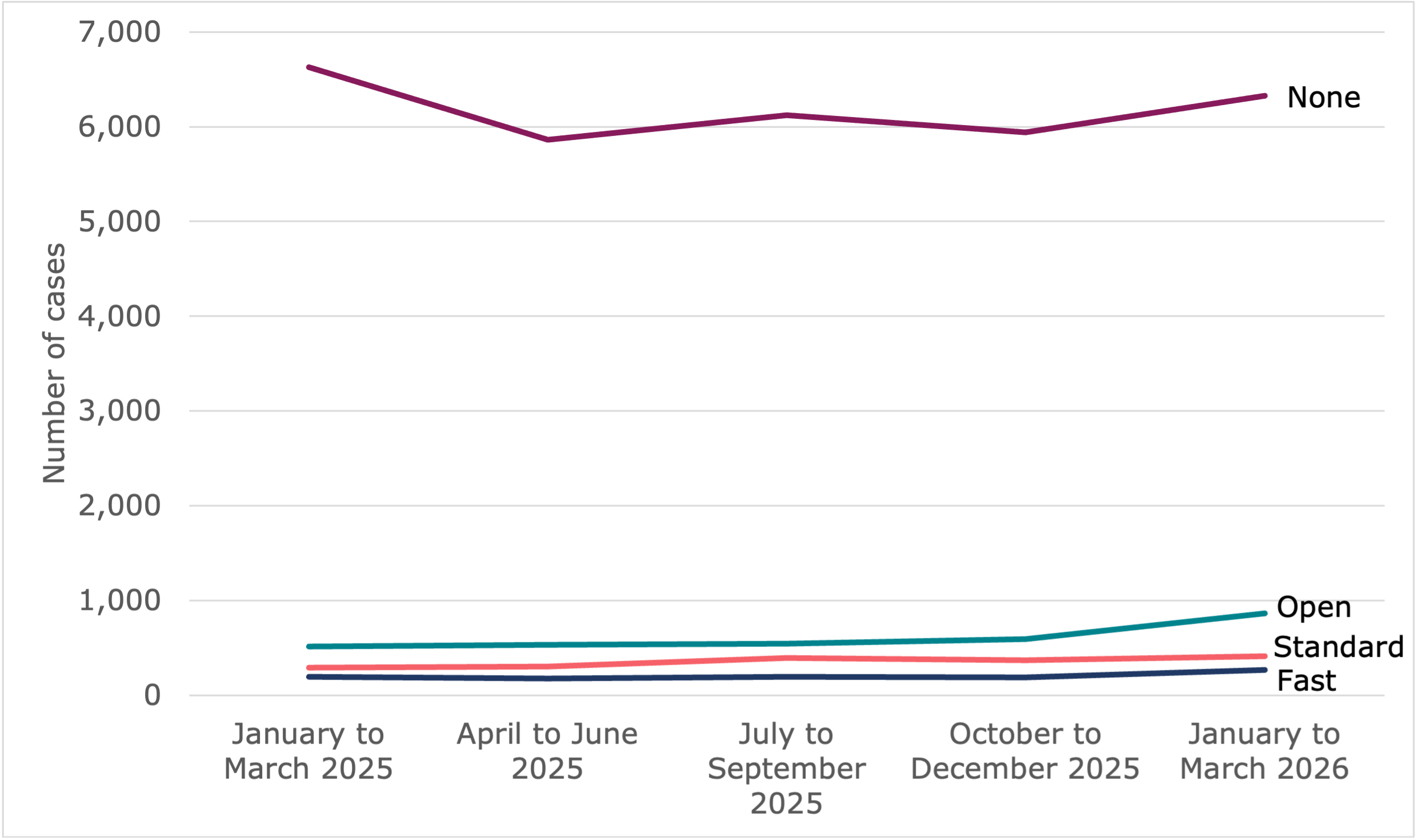
- Cases that did not progress to conciliation increased by 11%, and total closed cases increased by 9% in January to March 2025. However, the percentage of closed cases that were not conciliated stayed the same as in October to December 2025.
- 68% of early conciliation notifications did not progress to employment tribunal between October and December 2025, which is a 2 percentage point improvement from the previous quarter.
- In January to March 2026, 80% of cases did not proceed to a hearing, a one percentage point increase from the previous quarter.
2. Early conciliation notifications
When a worker wants to make a claim against their employer at an employment tribunal, in most cases they must notify Acas first. Acas offers early conciliation to try to reach an agreement between the worker and employer and avoid the worker making a claim to an employment tribunal.
In some circumstances, the employer may approach Acas to help resolve a potential dispute. This can also be handled using early conciliation.
Early conciliation notifications can be made:
- by an individual against their employer
- on behalf of a group against their employer
- by an employer where a dispute concerning staff requires resolution
Worker-led early conciliation notifications
Around 97% of all early conciliation notifications came from workers in January to March 2026. This is consistent with the previous 5 quarters from January 2025 to March 2026, during which the proportion fluctuated between 94% and 97%.
Open track group cases accounted for 61% of all cases in January to March 2026, increasing from 54% in the previous quarter, representing a 7 percentage point increase.
Open track cases accounted for 41% of worker‑led individual cases in January to March 2026, consistent with the previous quarter, despite increases in both open track volumes and overall case numbers.
| Quarter | Individual | Group |
|---|---|---|
| January to March 2025 | 7,353 | 94 |
| April to June 2025 | 7,213 | 89 |
| July to September 2025 | 7,412 | 70 |
| October to December 2025 | 7,689 | 68 |
| January to March 2026 | 8,712 | 68 |
| Quarter | Individual | Group |
|---|---|---|
| January to March 2025 | 6,696 | 149 |
| April to June 2025 | 6,035 | 61 |
| July to September 2025 | 6,282 | 41 |
| October to December 2025 | 6,125 | 33 |
| January to March 2026 | 6,486 | 36 |
| Quarter | Individual | Group |
|---|---|---|
| January to March 2025 | 11,639 | 163 |
| April to June 2025 | 12,652 | 206 |
| July to September 2025 | 13,933 | 234 |
| October to December 2025 | 14,533 | 237 |
| January to March 2026 | 16,500 | 294 |
| Quarter | Individual | Group |
|---|---|---|
| January to March 2025 | 6,205 | 73 |
| April to June 2025 | 6,479 | 72 |
| July to September 2025 | 6,706 | 86 |
| October to December 2025 | 7,369 | 97 |
| January to March 2026 | 8,124 | 82 |
| Quarter | Individual | Group | Claimants within Group |
|---|---|---|---|
| January to March 2025 | 31,893 | 479 | 20,229 |
| April to June 2025 | 32,379 | 428 | 17,449 |
| July to September 2025 | 34,333 | 431 | 11,396 |
| October to December 2025 | 35,716 | 435 | 13,888 |
| January to March 2026 | 39,822 | 480 | 13,708 |
Employer-led early conciliation notifications
Employer-led early conciliation notifications made up around 3% of early conciliation notifications between January and March 2026. This has decreased by 3 percentage points from the previous quarter (October to December 2025).
The total number of employer‑led cases fell to 1,273 in January to March 2026, down from 2,379 in October to December 2025 – a 46% decline, with fast track cases showing the largest drop at 55%.
Despite this overall fall, standard track cases continued to account for the largest share of employer‑led cases at 67%, a proportion that remained unchanged from previous quarters.
| Quarter | Fast track | No track | Open track | Standard track | Total |
|---|---|---|---|---|---|
| January to March 2025 | 205 | [suppressed] | 277 | 1,360 | 1,842 |
| April to June 2025 | 257 | [suppressed] | 323 | 1,436 | 2,016 |
| July to September 2025 | 148 | [suppressed] | 309 | 1,125 | 1,125 |
| October to December 2025 | 245 | [suppressed] | 531 | 1,603 | 1,603 |
| January to March 2026 | 111 | [suppressed] | 304 | 857 | 1,273 |
3. Early conciliation notification outcomes
Some early conciliation notifications are not suitable for conciliation, and the service is not mandatory so some claimants will refuse the offer.
Early conciliation cases that did not progress to conciliation
Between January and March 2026, around 19% of early conciliation cases were closed without parties engaging in early conciliation.
Despite the increase in both the total number of closed cases and the number of cases that closed without progressing to conciliation, the proportion of closed cases not conciliated remained unchanged from the previous quarter. This means that, because overall case volumes were higher, a greater number of cases were conciliated before closure in total, even though the percentage stayed the same. Cases with no track assigned accounted for 80% of all cases that did not conciliate between January and March 2026. These are cases where Acas was unable to contact the claimant to gather enough information to assign a track, so this outcome is expected.
This proportion declined by 4 percentage points from October to December 2025, fell by 2 percentage points compared with April to June 2025, and was down from 87% in the preceding 2 quarters.
Fast track cases made up the smallest proportion of cases that did not progress to conciliation, accounting for 3% or less in each of the last 5 quarters. Among cases with an assigned track, open track cases consistently represented the largest share of cases not conciliated across the 5 quarters from January 2025 to March 2026. This proportion was 11% between January and March 2026, rising slightly from 8% in October to December 2025.
| Track | January to March 2025 | April to June 2025 | July to September 2025 | October to December 2025 | January to March 2026 |
|---|---|---|---|---|---|
| Fast | 196 | 174 | 193 | 191 | 266 |
| None | 6,625 | 5,864 | 6,122 | 5,938 | 6,326 |
| Open | 517 | 534 | 546 | 595 | 866 |
| Standard | 290 | 304 | 393 | 368 | 414 |
| Total cases closed that did not progress to conciliation | 7,628 | 6,876 | 7,254 | 7,093 | 7,872 |
| Total cases closed | 31,940 | 34,039 | 36,132 | 3,7372 | 40,719 |
| Percentage of closed cases not conciliated | 24 | 20 | 20 | 19 | 19 |
Settlement of early conciliation cases
This data is reported 1 quarter behind the other statistics in this bulletin. This is due to the time lag between issuing an early conciliation certificate and the corresponding ET1 form. Tables 4a to 4e cover early conciliation, worker-led and group cases only, and are based on outcomes of cases received in October to December 2026.
The percentage of cases that did not progress to an employment tribunal increased to 68% in October to December 2025, up from 64% in July to September 2025, showing a 4 percentage point improvement in early resolution. This rise is supported by increases in both cases settled by Acas (3,624, up from 3,452) and ET1 avoided cases (24,699, up from 22,364), indicating that more disputes were successfully resolved before reaching tribunal.
Standard track showed the most significant improvement, with the number of cases that avoided ET1 form submission increasing to 5,285 in October to December 2025 from 4,444 in July to September 2025, resulting in a 19% growth.
Fast track cases were the most likely not to progress to an employment tribunal, with the proportion rising to 79% in October to December 2025, up from 76% in the previous quarter, showing a 3 percentage point improvement in early resolution. In contrast, cases with no assigned track were least likely to avoid tribunal progression, increasing only slightly from 61% to 62%, which highlights the consistently stronger early‑resolution performance within fast track compared with none track cases.
| Quarter | Settled by Acas | ET1 avoided | Percentage did not progress to employment tribunal |
|---|---|---|---|
| October to December 2024 | 898 | 5,548 | 79% |
| January to March 2025 | 907 | 5,568 | 79% |
| April to June 2025 | 918 | 5,653 | 77% |
| July to September 2025 | 918 | 5,700 | 76% |
| October to December 2025 | 954 | 6,094 | 79% |
| Quarter | Settled by Acas | ET1 avoided | Percentage did not progress to employment tribunal |
|---|---|---|---|
| October to December 2024 | [suppressed] | 4,230 | 66% |
| January to March 2025 | [suppressed] | 3,930 | 63% |
| April to June 2025 | [suppressed] | 3,750 | 62% |
| July to September 2025 | [suppressed] | 3,842 | 61% |
| October to December 2025 | [suppressed] | 3,830 | 62% |
| Quarter | Settled by Acas | ET1 avoided | Percentage did not progress to employment tribunal |
|---|---|---|---|
| October to December 2024 | 1,186 | 6,367 | 63% |
| January to March 2025 | 1,464 | 6,975 | 64% |
| April to June 2025 | 1,467 | 7,550 | 59% |
| July to September 2025 | 1,467 | 8,378 | 59% |
| October to December 2025 | 1,577 | 9,490 | 64% |
| Quarter | Settled by Acas | ET1 avoided | Percentage did not progress to employment tribunal |
|---|---|---|---|
| October to December 2024 | 843 | 3,840 | 68% |
| January to March 2025 | 1,041 | 4,272 | 70% |
| April to June 2025 | 1,064 | 4,466 | 68% |
| July to September 2025 | 1,064 | 4,444 | 65% |
| October to December 2025 | 1,091 | 5,285 | 71% |
| Quarter | Settled by Acas | ET1 avoided | Percentage did not progress to employment tribunal |
|---|---|---|---|
| October to December 2024 | 2,927 | 19,985 | 69% |
| January to March 2025 | 3,412 | 20,745 | 68% |
| April to June 2025 | 3,449 | 21,419 | 66% |
| July to September 2025 | 3,452 | 22,364 | 64% |
| October to December 2025 | 3,624 | 24,699 | 68% |
4. Employment tribunal claim form (ET1) receipts
If a case is not resolved by early conciliation, the claimant can submit an ET1 form to make a claim to an employment tribunal. Conciliation can also be carried out at this stage to try to resolve the case without progressing to tribunal.
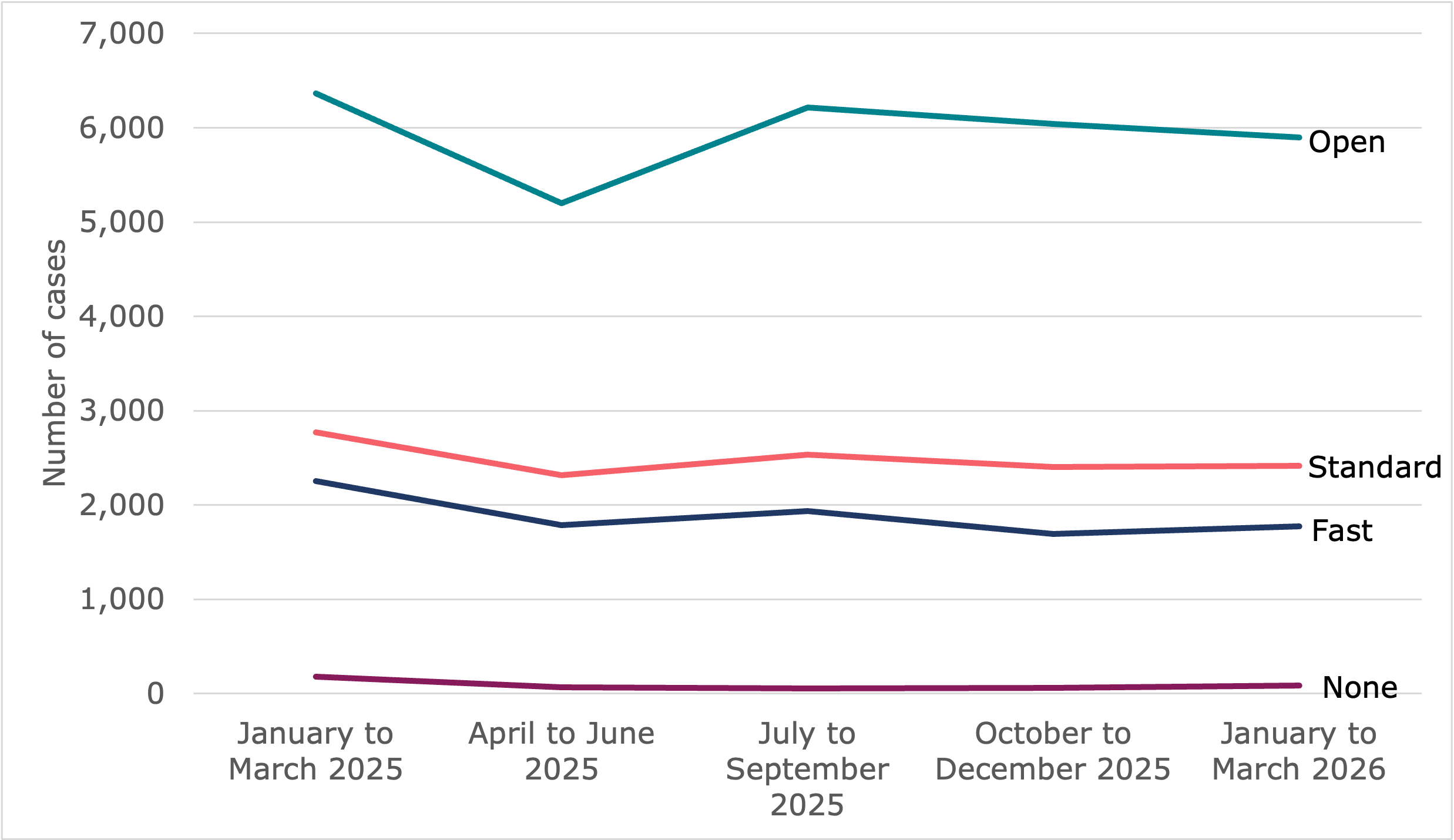
The highest level of ET1 receipts was recorded in open track cases, accounting for around 58% of all ET1 receipts in January to March 2026. This is a 1 percentage point decrease from 59% observed in the previous quarter.
The lowest proportion of ET1 receipts was received in cases with no track assigned, accounting for less than 1.5% of all ET1 receipts in each of the 5 quarters between January 2025 and March 2026.
| Quarter | Fast track | No track | Open track | Standard track |
|---|---|---|---|---|
| January to March 2025 | 2,256 | 177 | 6,364 | 2,771 |
| April to June 2025 | 1,788 | 67 | 5,201 | 2,317 |
| July to September 2025 | 1,935 | 53 | 6,216 | 2,532 |
| October to December 2025 | 1,691 | 64 | 6,039 | 2,402 |
| January to March 2026 | 1,771 | 85 | 5,899 | 2,416 |
5. Employment tribunal claims outcomes
This data is based on cases that had an outcome within the quarters covered in this bulletin. It does not correspond to the cases that were received in Table 5.
80% of all employment tribunal cases that had an outcome in January to March 2026 did not progress to a hearing. This is a 1 percentage point increase from 79% observed in the previous quarter. However, this shows a consistent pattern across January 2025 to March 2026. Among cases with an assigned track, open track cases were the least likely to progress to a hearing, while fast track cases were the most likely to do so.
Acas settled around 69% of cases that did not progress to a tribunal hearing in January to March 2026. This is a 4 percentage point decrease from 73% observed in October to December 2025, although a similar figure to the other quarters presented in this bulletin. The remaining cases were withdrawn.
| Quarter | Settled by Acas | Withdrawn | Percentage did not have hearing |
|---|---|---|---|
| January to March 2025 | 758 | 419 | 61% |
| April to June 2025 | 554 | 311 | 63% |
| July to September 2025 | 457 | 285 | 59% |
| October to December 2025 | 529 | 282 | 64% |
| January to March 2026 | 491 | 311 | 63% |
| Quarter | Settled by Acas | Withdrawn | Percentage did not have hearing |
|---|---|---|---|
| January to March 2025 | [suppressed] | [suppressed] | [suppressed] |
| April to June 2025 | [suppressed] | [suppressed] | [suppressed] |
| July to September 2025 | [suppressed] | [suppressed] | [suppressed] |
| October to December 2025 | [suppressed] | [suppressed] | [suppressed] |
| January to March 2026 | [suppressed] | [suppressed] | [suppressed] |
| Quarter | Settled by Acas | Withdrawn | Percentage did not have hearing |
|---|---|---|---|
| January to March 2025 | 2,639 | 1,059 | 84% |
| April to June 2025 | 2,228 | 758 | 85% |
| July to September 2025 | 2,146 | 852 | 86% |
| October to December 2025 | 2,166 | 824 | 85% |
| January to March 2026 | 2,156 | 885 | 85% |
| Quarter | Settled by Acas | Withdrawn | Percentage did not have hearing |
|---|---|---|---|
| January to March 2025 | 1,214 | 430 | 77% |
| April to June 2025 | 1,045 | 286 | 78% |
| July to September 2025 | 969 | 360 | 80% |
| October to December 2025 | 1,072 | 314 | 77% |
| January to March 2026 | 1,036 | 436 | 81% |
| Quarter | Settled by Acas | Withdrawn | Percentage did not have hearing |
|---|---|---|---|
| January to March 2025 | 4,611 | 1,908 | 77% |
| April to June 2025 | 3,827 | 1,355 | 79% |
| July to September 2025 | 3,572 | 1,497 | 79% |
| October to December 2025 | 3,767 | 1,420 | 79% |
| January to March 2026 | 3,683 | 1,644 | 80% |
6. Glossary
Conciliation or conciliating
The process of negotiation when an Acas conciliator mediates between parties in an employment dispute to try and reach agreement without going to an employment tribunal.
Conciliator
An Acas employee whose role is to mediate or conciliate between parties in an employment dispute.
Early conciliation
Acas service introduced in April 2014. Acas offers early conciliation to try and reach an agreement between parties before a formal employment tribunal claim. The prospective claimant submits an early conciliation notification to Acas, usually online, and Acas will then offer them early conciliation.
Early conciliation notification
Submission to Acas (usually online) required to begin conciliation.
Employment tribunal (ET)
Court of law charged with hearing cases within employment jurisdictions, although cases with monetary value may be heard elsewhere.
ET1
Form used by claimants to make a claim to an employment tribunal. The form is copied to Acas to allow ET1 conciliation to proceed until either the dispute is resolved, or a legal judgement is reached. It's free to submit an ET1.
ET1 avoided
Disputes that, at the time of publication, had led to an early conciliation notification but an ET1 had not been submitted.
Post-ET1 conciliation
Acas has a duty to attempt conciliation between the claimant and their employer once an ET1 has been submitted and passed to Acas. If a settlement can be reached or if the claimant agrees to withdraw their claim, the dispute is considered to be resolved. Otherwise, it will proceed to an employment tribunal hearing.
Group case
Cases which have been grouped together for conciliation because they are against the same employer and relate to the same dispute. 'Claimants in groups' are the number of claimants represented by these group claims.
Jurisdiction
Legal classification of the type of dispute a claim is made about. One case may contain more than one jurisdiction. For example, an unfair dismissal claim may also contain a claim under the Wages Act for unpaid wages. This could be changed in an employment tribunal.
Live case
Early conciliation notifications or ET1s still going through the conciliation process.
Track
How Acas loosely classes the complexity of each case, based on the jurisdictions in the ET1 form, or the suggested jurisdictions assigned to early conciliation notifications.
The 4 tracks are:
- fast track – straightforward cases mostly relating to money, such as unpaid wages
- standard track – cases that are more complicated than fast track and involve unfair dismissal or a related jurisdiction
- open track – the most legally complex cases with at least one type of discrimination or disclosure jurisdiction
- no track assigned – cases where insufficient information is available to assign indicative jurisdictions (for example, where parties cannot be contacted)
7. Quality
You can find more information in the methodology article and background quality reports on:
- strengths in the data
- limitations of the data
- appropriate uses of the data
- how the data was created